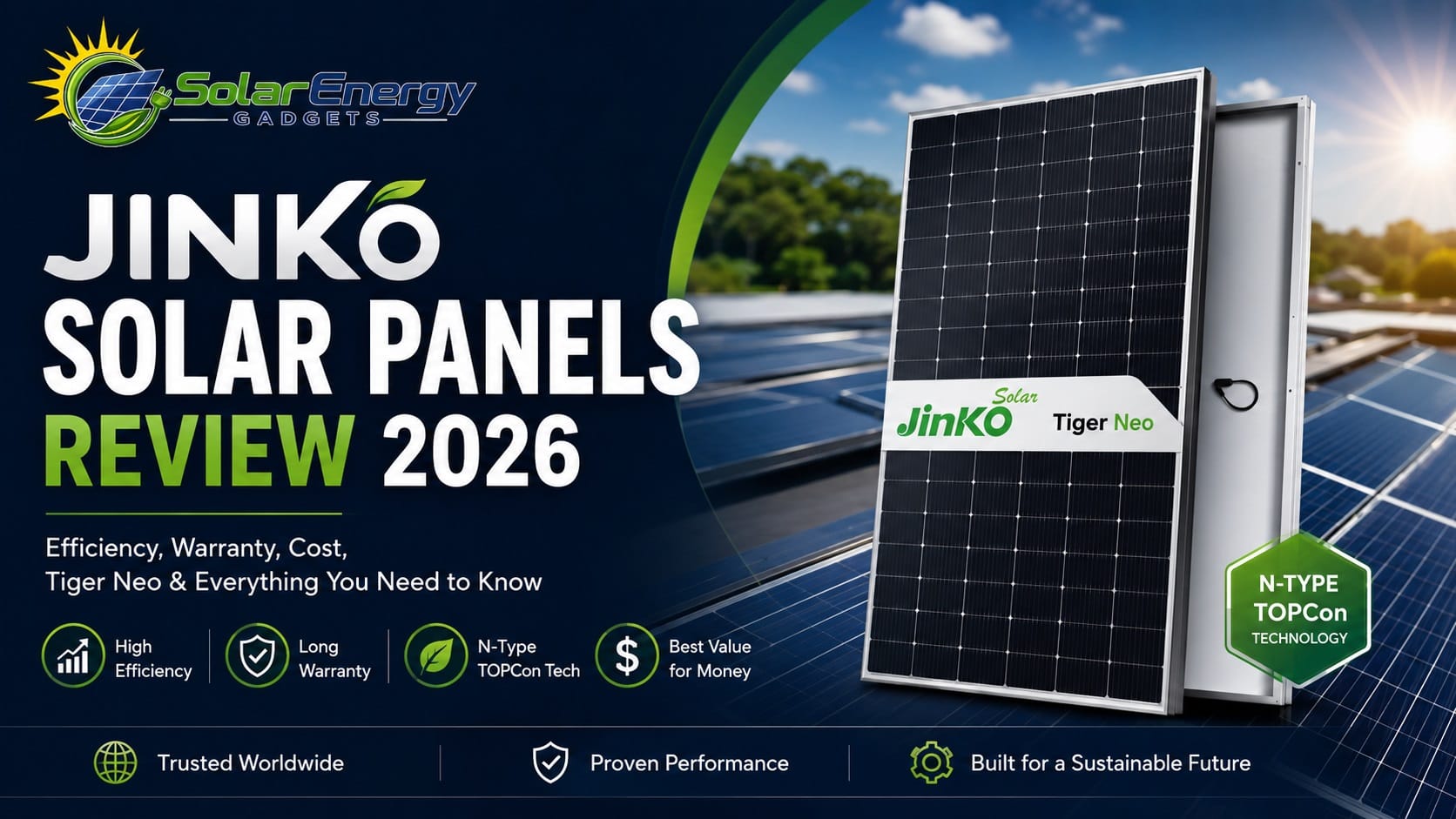
Jinko Solar Panels: Quick Verdict
Are Jinko Solar Panels good? Yes. JinkoSolar has become one of the world’s largest solar module manufacturers, with a strong reputation for combining competitive pricing with high-efficiency technology.
The company has invested heavily in N-type TOPCon technology, with its newer Tiger Neo products pushing module efficiency well above 23%. Jinko’s official specifications for the Tiger Neo 3.0 include up to 24.8% module efficiency, 670W output and 85% ± 5% bifaciality for applicable models.
Independent reviews also place Jinko among the strongest value-oriented solar panel brands. SolarReviews ranked Jinko fifth in its 2025 solar panel scoring system, while SolarQuotes’ 2026 installer survey placed Jinko second among budget solar panel brands in Australia.
That does not mean every Jinko panel is identical. The model, installation quality, climate, roof conditions, inverter and warranty terms all matter. This Jinko Solar Panels Review looks at these key factors to help homeowners and businesses make a confident decision.
For homeowners and businesses comparing solar panels in 2026, Jinko deserves to be on the shortlist.
What Is JinkoSolar?
JinkoSolar is a global solar photovoltaic manufacturer headquartered in China. It produces solar modules and energy solutions for residential, commercial and utility-scale applications.
The company has built a large international manufacturing and distribution footprint. Jinko’s reported annual production capacity at the end of 2025 included approximately 120 GW of monocrystalline silicon wafers, 95 GW of solar cells and 130 GW of solar modules, illustrating the enormous scale of its manufacturing operation.
Scale matters when you are choosing equipment expected to operate for decades. A large manufacturer typically has greater resources for research, quality control, product development and warranty support than a small or newly established brand.
Jinko has also developed a strong research and development profile around N-type TOPCon technology. Its Tiger Neo range has become one of its most important product families.
SolarReviews notes that Jinko has appeared on the PVEL Reliability Scorecard over many years and identifies the company as a BloombergNEF Tier 1 manufacturer.
It is important to understand that Tier 1 is primarily a bankability and market classification, not a guarantee that every panel is superior to every competing panel. The actual module specifications and installation quality still matter.
Why Are Jinko Solar Panels So Popular?
The biggest reason is simple: value.
Solar buyers generally want three things: strong electricity production, long-term reliability and a reasonable upfront cost. Jinko has positioned itself directly in that space.
Its newer N-type TOPCon panels can provide high efficiency without necessarily carrying the premium price associated with some of the most expensive solar brands.
SolarQuotes describes Jinko as good-quality, well-priced panels from one of the world’s largest manufacturers and highlights its Australian presence and support network.
SolarReviews similarly concludes that Jinko combines good specifications, quality and reasonable pricing, making the brand a strong value proposition.
For buyers, that combination can be particularly attractive when the goal is not simply to purchase the panel with the highest laboratory efficiency, but to build the best overall solar system for the budget.
Jinko Tiger Neo: The Series Driving Jinko’s Technology
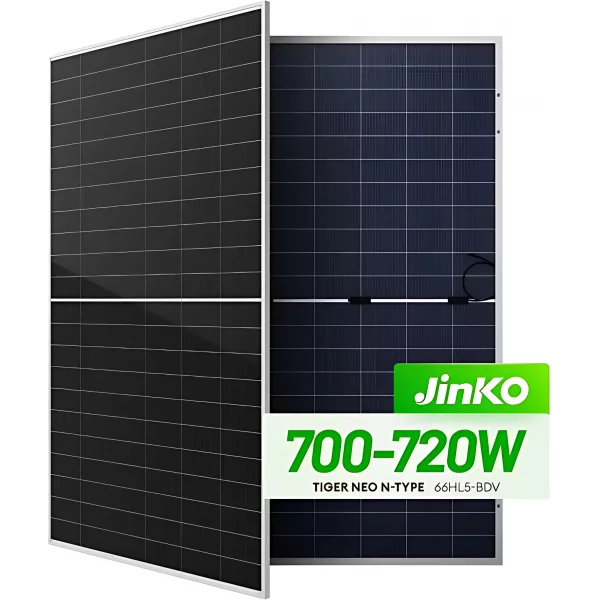
When researching Jinko Solar Panels, you will probably encounter the name Tiger Neo.
Tiger Neo represents Jinko’s N-type TOPCon-focused technology platform. Compared with older P-type PERC technology, N-type TOPCon is designed to improve efficiency, reduce certain degradation mechanisms and deliver stronger performance in real-world conditions.
Jinko’s current Tiger Neo technology page lists features including high efficiency, improved bifacial gain, enhanced reliability, lower LID and LETID, optimized temperature coefficients and strong low-light performance.
The latest Tiger Neo 3.0 generation pushes this technology even further.
According to Jinko, Tiger Neo 3.0 can reach:
| Feature | Tiger Neo 3.0 |
| Maximum power | Up to 670W |
| Module efficiency | Up to 24.8% |
| Bifaciality | Up to 85% ± 5% |
| Power warranty | Up to 30 years |
| Technology | N-type TOPCon |
| Temperature coefficient | As low as -0.26%/°C |
Jinko also launched the Tiger Neo 5.0 generation in 2026, reporting up to 700W output and 25.91% module efficiency for its new-generation modules.
However, buyers should not automatically assume that the newest flagship panel is the best choice for a home. A residential roof may benefit more from a compact, high-efficiency module than a very large utility-scale module.
The best Jinko Solar Panel is the model that fits your roof, energy consumption, inverter and budget.
Jinko Solar Panel Efficiency Explained
Efficiency is one of the most searched specifications when people compare solar panels.
Solar panel efficiency tells you how effectively a module converts available sunlight into electricity.
For example, a 24% efficient module converts a larger proportion of incoming solar energy into electricity than a 20% efficient module under the same test conditions.
Higher efficiency becomes especially useful when roof space is limited.
SolarReviews reports that the Eagle G6 range available in the U.S. reaches 22.53% efficiency, while Jinko’s newer global Tiger Neo generations have moved beyond that level.
Jinko’s current global Tiger Neo 3.0 specifications reach up to 24.8%.
That sounds impressive, but efficiency should not be the only buying factor.
A slightly lower-efficiency panel can sometimes deliver better overall value because of its lower price. Likewise, a premium panel can be worthwhile when your roof is small and every square metre matters.
N-Type TOPCon Technology: Why It Matters
The transition from P-type PERC to N-type technologies is one of the most important developments in modern solar panels.
TOPCon stands for Tunnel Oxide Passivated Contact.
In practical terms, TOPCon is designed to reduce energy losses within the solar cell and improve conversion performance.
Jinko’s Tiger Neo platform uses N-type TOPCon cells, with the company highlighting improved efficiency, low-light performance, lower degradation and strong temperature characteristics.
This can be useful in a variety of environments.
Solar panels do not operate only under perfect laboratory conditions. Real rooftops experience hot temperatures, changing sunlight, clouds, dust and seasonal differences.
A panel that maintains stronger performance under these conditions can produce more useful energy over its lifetime.
Jinko Solar Panels in Hot Climates
Temperature matters.
Solar modules generally lose some power as cell temperature rises. This is why the temperature coefficient is worth checking when comparing panels.
Jinko lists temperature coefficients as low as -0.26%/°C for its latest Tiger Neo technology.
The importance of this specification depends on your climate and installation conditions.
For homeowners in hot regions, strong thermal performance can help protect energy production during periods when the panels are exposed to intense sunlight and high ambient temperatures.
This does not mean a Jinko panel will produce its rated power on a very hot afternoon. Rated power is measured under standardized test conditions. Real-world output depends on temperature, sunlight intensity, orientation, shading, inverter clipping and many other variables.
Jinko Solar Panel Warranty and Degradation
Warranty is one of the most important parts of buying solar panels because you are making a long-term investment.
Modern Jinko panels can carry lengthy product and performance warranties, but the exact terms depend on the specific series, market and model.
For example, SolarReviews lists a 25-year product warranty and 30-year power warranty for the Eagle G6, with 87.4% power remaining at year 30 under the cited warranty terms.
Jinko’s Tiger Neo platform also advertises a 30-year power warranty, with the company highlighting low first-year degradation and low annual linear degradation.
This is important because a solar panel’s value is not based only on how much electricity it produces in year one.
A panel should ideally continue producing useful amounts of electricity decades later.
Always check the exact warranty document for the model you are buying. Product warranty, performance warranty, installation warranty and workmanship warranty are separate things.
How Much Do Jinko Solar Panels Cost?
There is no single worldwide Jinko Solar panel price.
Costs depend heavily on country, model, wattage, local taxes, distributor margins, shipping, currency, installation and government incentives.
For example, an Australian supplier currently lists Jinko panels at approximately AUD $110 to $200 per panel, depending on the model and power rating. Its listed Tiger Neo 440W pricing is around AUD $155 to $180 per panel. These are indicative prices and can change.
SolarReviews uses a different U.S. market basis and notes that a solar system using Jinko modules can cost around $2.60 per watt before incentives, while also emphasizing that installation complexity and installer choice affect the final price.
Therefore, comparing panel prices online can be misleading.
The better question is:
What will the complete solar system cost, and how much electricity will it generate over its lifetime?
A cheaper panel is not necessarily cheaper if it requires more roof area, delivers lower energy production or comes with weaker system components.
Jinko Solar Panels Pros and Cons
Pros
- Strong value for money: Jinko has built its reputation around competitive pricing combined with strong technical specifications.
- High efficiency: Newer Jinko N-type TOPCon modules can reach very high efficiency ratings.
- Long warranty options: Many current Jinko products include long product and performance warranty terms, depending on model and market.
- Large global manufacturer: Jinko operates at significant manufacturing scale, which can provide confidence in long-term product availability and corporate resources.
- Wide product selection: Jinko produces panels for residential, commercial and utility-scale projects.
- Strong independent feedback: SolarQuotes currently shows thousands of Jinko customer reviews and a very high overall manufacturer score.
Cons
- Not every Jinko model is the same: Older and entry-level panels should not be compared directly with the newest Tiger Neo products.
- Installation quality matters: Even an excellent panel can underperform when installed incorrectly.
- Large high-power modules may not suit every roof: The biggest panels can be better suited to commercial or utility applications.
- Global specifications differ: A model available in one country may not be available in another.
- Premium efficiency costs more: The latest flagship Jinko modules can cost more than older or lower-output models.
Are Jinko Solar Panels Good for Homeowners?
For many homeowners, yes.
Jinko can be particularly attractive when you want a balance between performance and cost rather than paying for the most expensive brand available.
The key is choosing the right panel for your actual roof.
A home with limited roof space may benefit from a high-efficiency Tiger Neo module. A larger roof may allow you to save money by selecting a slightly lower-cost module without losing the ability to install the required system capacity.
Your installer should also consider shading, roof orientation, tilt angle, inverter capacity, string configuration and future battery requirements.
Do not choose a solar panel based on brand name alone.
Choose the complete system.
Jinko vs LONGi vs Trina: Which Is Better?
This is one of the most common questions asked by solar shoppers.
The reality is that there is no universal winner.
Jinko, LONGi and Trina are all major global solar manufacturers with high-efficiency N-type technologies and extensive international markets.
Instead of asking which logo is better, compare:
| Buying Factor | What to Check |
| Efficiency | Higher is useful when roof space is limited |
| Warranty | Product and performance terms |
| Degradation | Expected long-term output |
| Temperature coefficient | Important in hot climates |
| Panel dimensions | Must fit roof layout |
| Installer quality | Critical for long-term performance |
| Price | Compare complete installed systems |
| Local support | Important for warranty assistance |
| Inverter | Should be properly matched to the panels |
| Battery compatibility | Important if adding storage later |
In many projects, the installer and system design can have a larger impact on your experience than the small specification difference between two reputable panel brands.
Do Jinko Solar Panels Work in Australia?
Yes.
Jinko has a significant presence in the Australian solar market, and SolarQuotes describes the company as having a strong Australian presence and local support.
Australian supplier listings also show multiple Jinko panel models marketed for residential and commercial installations.
For Australian buyers, however, always confirm that the exact panel model is approved for your installation and that the quoted warranty and support arrangements apply in Australia.
Solar incentive eligibility, electrical requirements and approved product lists can change over time, so current local rules should be checked before purchase.
Are Jinko Solar Panels Worth Buying in 2026?
Our verdict is yes, with the right model and installer.
Jinko’s biggest strength is its combination of manufacturing scale, research and development, modern N-type TOPCon technology, competitive pricing and long-term product support.
The latest Tiger Neo generations show how far the brand has moved from being simply a budget-focused solar manufacturer. Jinko’s technology portfolio now reaches extremely high power and efficiency levels, including Tiger Neo 3.0 at up to 24.8% efficiency and the newly announced Tiger Neo 5.0 at up to 25.91% efficiency for specific products.
But maximum efficiency does not automatically equal maximum savings.
Your best system depends on your electricity consumption, roof size, local climate, energy prices, shading, battery plans and installation quality.
Final Verdict: Should You Buy Jinko Solar Panels?
Jinko Solar Panels are one of the strongest value choices in the global solar market in 2026.
They combine high-efficiency technology with the manufacturing scale and long-term experience of a major international PV company.
The Tiger Neo family is particularly interesting for buyers looking for N-type TOPCon technology, high efficiency, strong temperature performance and long-term output.
Independent sources support the brand’s position. SolarReviews highlights Jinko’s reliability, affordability and growing efficiency, while SolarQuotes currently reports strong homeowner ratings and installer feedback in Australia.
The most important takeaway is this:
Don’t buy a solar panel simply because it has the highest wattage or the lowest price. Buy the right combination of panel, inverter, installation and warranty for your property.
Ready to compare Jinko Solar Panels for your home or business?
Explore Jinko solar panel options, compare specifications and request a personalised solar quote from Solar Energy Gadgets today.
Frequently Asked Questions
Are Jinko Solar Panels good quality?
Yes. Jinko is one of the world’s largest solar manufacturers, and independent reviews generally position the company as a reliable, high-value solar panel manufacturer.
What is the most efficient Jinko Solar Panel?
Efficiency depends on the market and model. Jinko’s Tiger Neo 3.0 reaches up to 24.8% module efficiency, while Jinko announced Tiger Neo 5.0 modules reaching up to 25.91% for certain new-generation products in 2026.
How long do Jinko Solar Panels last?
Many modern Jinko panels come with long performance warranties, including 30-year terms on selected products. Actual service life depends on environmental conditions, installation quality and maintenance.
Are Jinko Solar Panels Tier 1?
JinkoSolar is widely identified as a Tier 1 solar manufacturer, including by industry sources discussing BloombergNEF’s Tier 1 classification. Tier 1 primarily relates to manufacturer bankability and market participation rather than being a universal quality certification.
Are Jinko Solar Panels expensive?
Jinko is generally positioned as a value-oriented major manufacturer, but the price varies substantially by model, country, distributor and installation. Australian supplier pricing, for example, currently ranges from roughly AUD $110 to $200 per panel across listed Jinko models.
Which Jinko panel should I choose?
That depends on your roof area, energy usage, climate, budget and inverter. High-efficiency Tiger Neo panels can make sense when roof space is limited, while other Jinko models may provide better value when roof space is plentiful.
Solar Energy Gadgets is a premier global hub for original, expert-led solar product reviews. Our dedicated team of specialists rigorously tests the latest renewable energy technology from around the world to ensure our readers receive unbiased and practical advice. Whether you are outfitting a suburban home or looking for the best off-grid gear, we provide the insights you need to harness the power of the sun with confidence.