Solar panel cleaning is one of the simplest ways to protect the output of a home solar system, but for most US households it doesn’t need to happen very often. In average conditions, cleaning your solar panels once or twice a year is enough to keep dust, pollen, and grime from building up. If you live in a dusty, pollen-heavy, or bird-heavy area, you may need to clean more often, and your monitoring app is the best guide to when. The safest and most effective approach to cleaning solar panels is also the gentlest. Use a soft brush or sponge, low-pressure water from a garden hose, and a mild biodegradable soap. Shut the system down at the inverter before you start. Never use a pressure washer, abrasive pads, or harsh chemicals, because they can scratch the glass, damage the anti-reflective coating, and put your panel warranty at risk.
The cost of solar panel cleaning depends on whether you do it yourself or hire someone. A reusable DIY solar panel cleaning kit, such as a soft-bristle brush on a telescopic water-fed pole, typically costs roughly $60 to $150 and can last for years. Professional solar panel cleaning for a full residential system usually runs about $150 to $350 per visit, with higher prices for steep roofs, two-story homes, or large arrays. Because prices vary by region and roof access, it’s worth getting a couple of local quotes before you commit.
Solar panel maintenance is worth doing, but it isn’t equally valuable in every location. Dirt on your panels, known as soiling, reduces solar panel efficiency by blocking sunlight from reaching the cells, and how much you lose depends heavily on your climate, your surroundings, and how often it rains. This guide breaks down how much output you’re really losing, what each cleaning option costs, and how to decide whether solar panel cleaning pays off for your home, so you can spend your time and money where it counts.
How Much Do Dirty Solar Panels Really Cost You?
Dirt on panels is called soiling, and the losses are smaller than many cleaning companies imply. According to PV Magazine, USA’s guide to solar production losses, NREL performance parameters treat about 5% soiling loss as typical in the US. Regions with year-round rain often sit around 2%. The same guide cites an NREL model in which one annual cleaning on a system with about 1.9% soiling loss cut it to roughly 1.5%.
Rain doesn’t fix everything. NREL research on pollen studied solar plants in North Carolina that had gone seven years without manual cleaning. Panel performance dropped by as much as 15% at the peak of pollen season, and annual losses without planned cleaning were on the order of 10%. Output didn’t fully recover after the season despite frequent rain, and wet-brush cleaning restored 5% to 11%.
| Situation | Typical soiling loss | Cleaning priority |
| Rainy region, few trees or dust sources | ~2% | Low: once a year or less |
| Average US conditions | ~5% | Moderate: 1–2 times a year |
| Long dry seasons, dusty roads, farms | 5–7%+ | High: quarterly or more |
| Heavy pollen (Southeast, oak/pine areas) | Up to ~10–15% seasonal | High: clean after pollen season |
| Bird droppings on individual panels | Localized, can be severe | Clean promptly by hand |
The Aurora Solar soiling guide points out that bird droppings behave differently from evenly spread dust. Rain often doesn’t remove them, and they call for a quick manual clean. A shaded cell also drags down production for the whole panel.
Is Professional Cleaning Worth It? A Quick ROI Check
Here’s the math most guides skip. This is an illustrative example, so swap in your own numbers.
- System: 8 kW, producing roughly 11,000 kWh a year
- Electricity rate: about $0.18/kWh
- Annual solar value: about $2,000
| Soiling loss you recover | Value of recovered production per year |
| 2% | ~$40 |
| 5% | ~$100 |
| 10% | ~$200 |
A 150–350 professional visit only pays for itself in one year if you’re recovering roughly 8–15% or more, such as in heavy pollen, dust, or bird situations. In average conditions, a DIY kit you reuse for years is the smarter value. Professional cleaning still makes sense if your roof is steep or high, since a fall costs far more than any cleaning bill.
Standard Solar Panel Sizes (So You Buy the Right Gear)
Panel size determines your pole length, brush width, and how many passes you’ll make.
| Panel type | Typical dimensions | Weight | Typical wattage |
| Standard residential (60-cell / equivalent) | ~65–67″ x 39–41″ (about 5.5 ft x 3.3 ft) | 40–50 lbs | 400–450W |
| Larger residential/commercial (72-cell) | ~77–79″ x 39–41″ | 50+ lbs | 500W+ |
| Frame thickness | 1.2–1.6″ | n/a | n/a |
A typical US home runs about 15–21 panels. For real brand specs, see our Qcells Solar Panels Review (Q.PEAK DUO and Q.TRON) and our LONGi Solar Review.
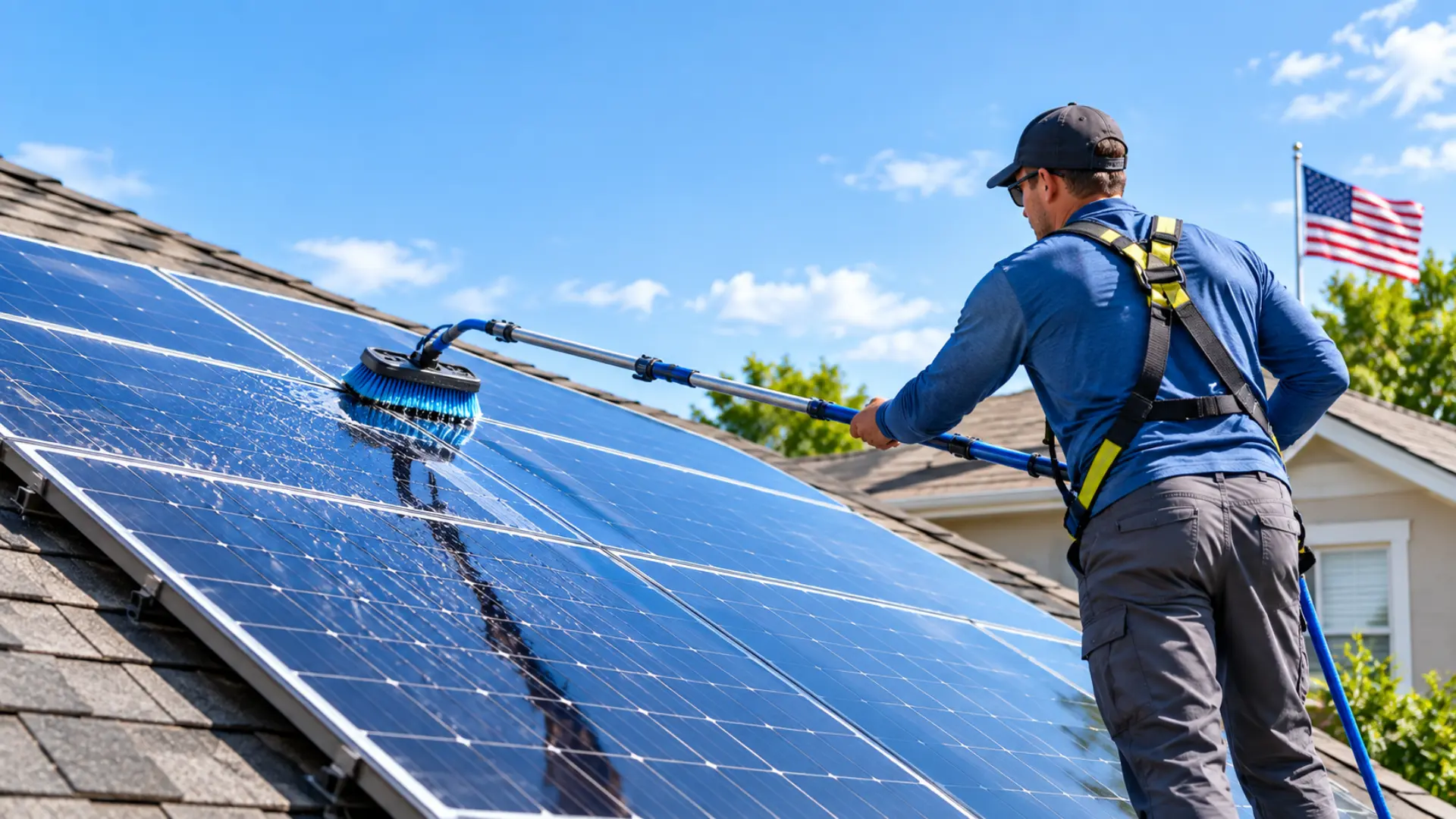
Pole reach rule of thumb: On a single-story home, a top-row panel can sit around 15 feet or more from the ground once you count eave height plus the roof slope. A 20–24 ft telescopic pole covers most cases. Panels beyond safe reach from the ground call for a pro.
When to Clean Solar Panels (By Region)
| Region/condition | Suggested frequency | Why |
| Arid Southwest (AZ, NV, inland CA) | Every 2–3 months, or per your monitoring app | Long dry seasons, dust |
| Southeast / oak-pine pollen zones | After spring pollen season, plus once more if output stays low | Rain doesn’t fully clear pollen |
| Agricultural/rural | Every 2–3 months in dry periods | Field dust and chaff |
| Coastal | Every 3–4 months | Salt film |
| Pacific Northwest, Northeast (frequent rain) | Once a year, or as needed | Rain does most of the work |
| After wildfire smoke, dust storms | As soon as it’s safe | Heavy one-time deposits |
Best time of day: Clean early morning or evening, when panels are cool. Hot glass dries water too fast and leaves streaks.
Snow: Don’t scrape panels. Wait for melt or use only a soft, long-handled snow tool from the ground. Snow can cause large seasonal losses for fixed-tilt systems, but scraping risks scratches and cracked glass.
Your Best Early Warning: Monitoring Gadgets
Don’t guess when to clean. Most inverters and microinverter systems have a free app that shows daily production. Compare a clear day now to a similar clear day from a few weeks ago. A slow decline that doesn’t match the weather is your cue to inspect or clean. A sudden drop points to a fault or shading, not dirt.
The Enphase cleaning and maintenance guide recommends routine monitoring (daily or weekly) and points out that rain alone isn’t a thorough cleaning method. The PNNL solar PV best practice page notes that most PV maintenance tasks are visual inspections, and that monitoring is key to catching problems.
DIY Solar Panel Cleaning Tools & Gadgets (With US Price Ranges)
Prices vary a lot by seller, so treat these as planning ranges and check current listings.
| Tool | What it does | Typical price |
| Soft-bristle brush or sponge | Basic scrub for reachable panels | 10–25 |
| Extension pole (non-powered) | Adds reach so you can stay on the ground | 20–50 |
| Telescopic water-fed brush kit | Brush plus continuous hose water, the most popular DIY option | 60–150 |
| Squeegee/finishing tool | Prevents water spots | 10–20 |
| Biodegradable mild soap | Lifts grime without harsh chemicals | 10–20 |
| Water filter / deionizing attachment | Prevents mineral spotting in hard-water areas | 30–80 |
| Electric rotating brush kit | Powered scrubbing for larger arrays | 150–350 |
| Heavy-duty carbon-fiber water-fed system | Long reach, pump, larger properties | 300–1,000+ |
| Bird deterrent/critter mesh kit | Stops nesting and droppings under panels | Varies, get a quote |
How to choose a kit:
- Bristle softness: Choose soft bristles or microfiber. Stiff brushes scratch.
- Pole length: Match it to your tallest reachable row (see the sizing note above).
- Weight: Carbon fiber is lighter and easier to hold at full extension.
- Hose fit: Check for a standard garden hose thread.
- Water flow control: A shut-off valve near the brush saves water and hassle.
About robotic cleaners: These are built for commercial and utility arrays, and the US Department of Energy notes robots are available for large systems. For a 15–20 panel home roof, a water-fed pole kit is far more practical and affordable.
Step-by-Step: How to Clean Solar Panels Yourself
- Check your warranty and manual. Some manufacturers specify approved methods. If your system is leased or on a PPA, ask your provider first.
- Pick a cool time (early morning or evening) and avoid windy days.
- Inspect from the ground. Look for cracked glass, loose frames, and damaged wiring. Stop and call an installer if you see damage.
- Shut down the system at the inverter per your owner’s manual. Note that panels still produce DC voltage in daylight, so never handle wiring.
- Rinse with a gentle spray to remove loose dust. Use low pressure only.
- Scrub gently with a soft brush and mild soapy water, working in small sections.
- Rinse thoroughly to remove all soap film.
- Air dry or squeegee any water spots.
- Restart the system and compare production over the next few sunny days.
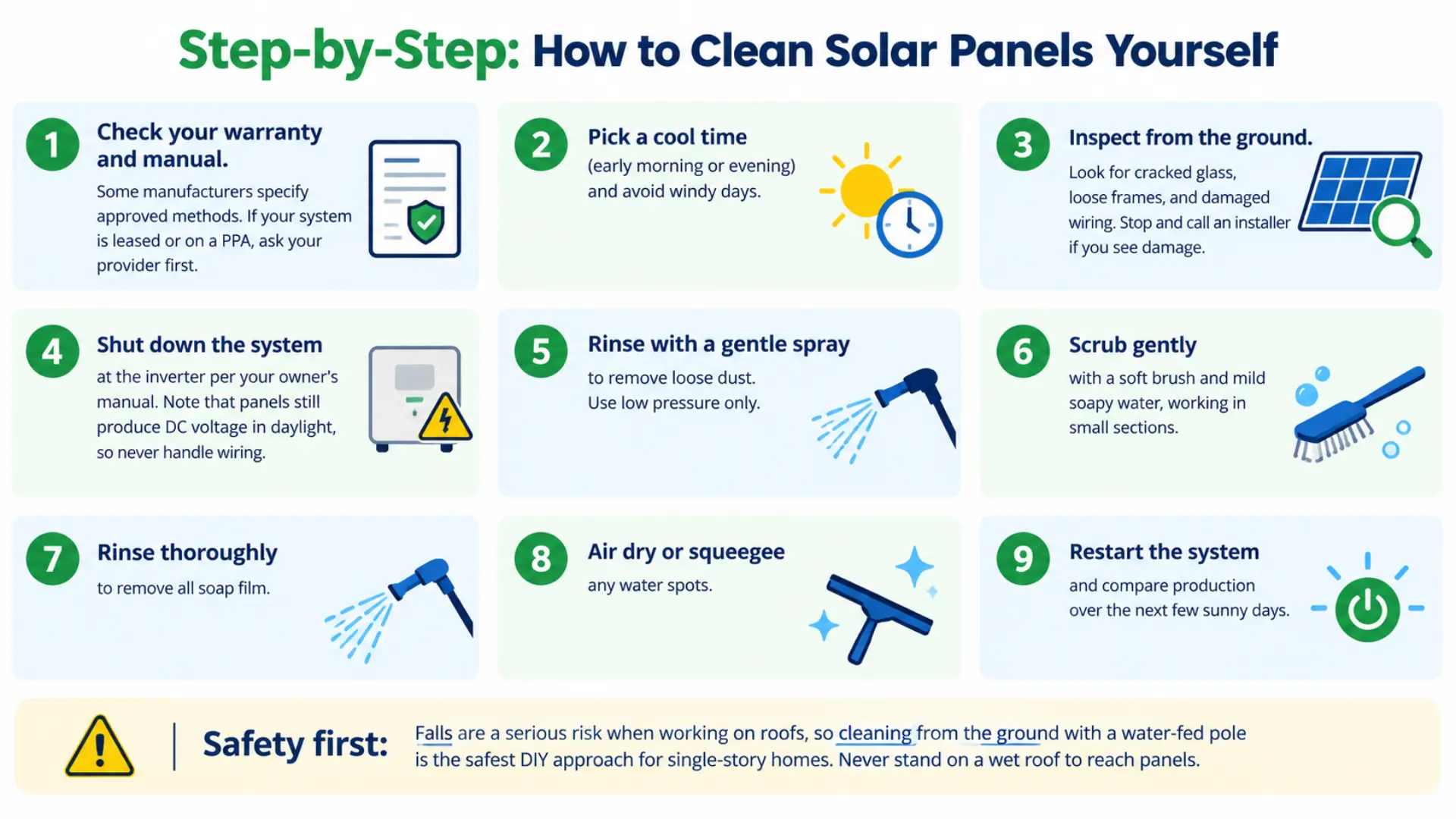
Safety first: Falls are a serious risk when working on roofs, so cleaning from the ground with a water-fed pole is the safest DIY approach for single-story homes. Never stand on a wet roof to reach panels.
What NOT to Do
- No pressure washers: They can damage panels and force water into seals.
- No abrasive pads or stiff brushes: Scratches scatter light permanently.
- No bleach, ammonia, or harsh solvents: They can damage coatings and frames.
- No cleaning hot panels: This causes streaks and stresses the glass.
- No toothpaste or DIY abrasives: They scratch.
- No climbing onto the roof without proper fall protection.
DIY vs. Professional: US Cost Comparison
| Option | Typical cost | Best for |
| DIY kit (reusable) | 0–150 up front | Single-story, ground-reachable panels |
| Professional cleaning per visit (full home system) | ~150–350 | Steep or two-story roofs, heavy soiling |
| Professional inspection (electrical check) | ~150–400 | Annual safety and connection checks |
| Annual maintenance plan (cleaning + inspection) | ~300–600/year | Hands-off owners |
Pricing ranges are drawn from SolarCleanHub’s 2026 maintenance guide and Solar Price List’s 2026 maintenance checklist. Get at least two local quotes, since prices vary by state and roof access. If you clean a portable setup rather than rooftop panels, our Best Portable Solar Panels 2026 and Top Portable Solar Panels for Camping & RV guides cover those products.
Beyond Cleaning: Full Solar Maintenance Checklist
- Trim vegetation. Shade from branches often costs more than dust. Trim before summer.
- Inspect visually every few months. Look for cracks, discoloration, corrosion, and burn marks near wiring.
- Keep the inverter clear. Vents and heatsinks should be free of dust, cobwebs, and pests. Watch for warning lights.
- Check after severe weather. Hail, high wind, and storms can loosen mounts or damage glass.
- Book a professional electrical inspection. Torque checks on DC connections, grounding, and rapid-shutdown function are best left to a licensed technician. The US Department of Energy’s PV life-cycle O&M guidance also stresses planned maintenance and monitoring.
- Keep records of cleanings and inspections for warranty claims.
Related Solar Gadgets for Your Home
Solar-powered devices around the house need the same basic care: keep the small panels clear of dust, leaves, and grime.
- Reolink Argus 4 Pro solar security camera review
- ieGeek ZY-C2 solar security camera review
- XLUX S60 solar pathway lights review
- Portable solar generators for emergencies: USA guide
- BigBlue 28W solar charger review
Did You Buy Solar Recently? A Note on Incentives
The 30% federal homeowner solar credit (Section 25D) ended for expenditures after December 31, 2025. The IRS FAQ on the One Big Beautiful Bill changes explains that an expenditure counts as made when installation is completed, and the Congressional Research Service overview covers the timing and carryforward rules. If you installed and completed by the deadline, keep your documents, since unused credit can carry forward. Check state and utility incentives too, since those vary. Cleaning and maintenance costs are not part of the credit.
Conclusion
Solar panel cleaning is simple, but it isn’t equally valuable for everyone. Typical US losses from dirt are modest, but pollen, dust, and bird droppings can raise them. Use your monitoring app to decide when to clean, invest in a soft-bristled, water-fed pole kit for ground-reachable arrays, and hire a professional when access is risky or soiling is heavy. Add vegetation trimming, inverter checks, and an occasional electrical inspection, and your system stays close to its rated output for decades.
Frequently Asked Questions on solar panel cleaning
How often should I clean my solar panels?
Once or twice a year for most US homes. Go more often if you live in a dusty, agricultural, coastal, or high-pollen area, or if your monitoring app shows a steady unexplained drop.
Do solar panels need cleaning if it rains a lot?
Often less, but not never. NREL research found rain didn’t fully clear pollen and that cleaning restored measurable output in a rainy region.
How much does it cost to clean solar panels?
DIY kits cost about $ 60–$ 150 and are reusable. Professional visits typically run about 150–350 for a full residential system.
Can I use tap water?
Yes. In hard-water areas, mineral spots can form, so use a filter or squeegee dry.
Does cleaning void my warranty?
It can if you use methods the manufacturer prohibits. Check your panel documentation and installer’s guidance first.
Should I turn the system off?
Yes. Follow your manual’s shutdown steps before cleaning, and never touch wiring or connectors.
Is a robotic solar panel cleaner worth it for a home?
Generally no. They’re designed for commercial and utility arrays, and a water-fed pole kit is far more cost-effective for a typical home.
Can I clean panels in winter?
Only if it’s safe and above freezing. Never use hot water on cold glass or scrape snow and ice.
Solar Energy Gadgets is a premier global hub for original, expert-led solar product reviews. Our dedicated team of specialists rigorously tests the latest renewable energy technology from around the world to ensure our readers receive unbiased and practical advice. Whether you are outfitting a suburban home or looking for the best off-grid gear, we provide the insights you need to harness the power of the sun with confidence.