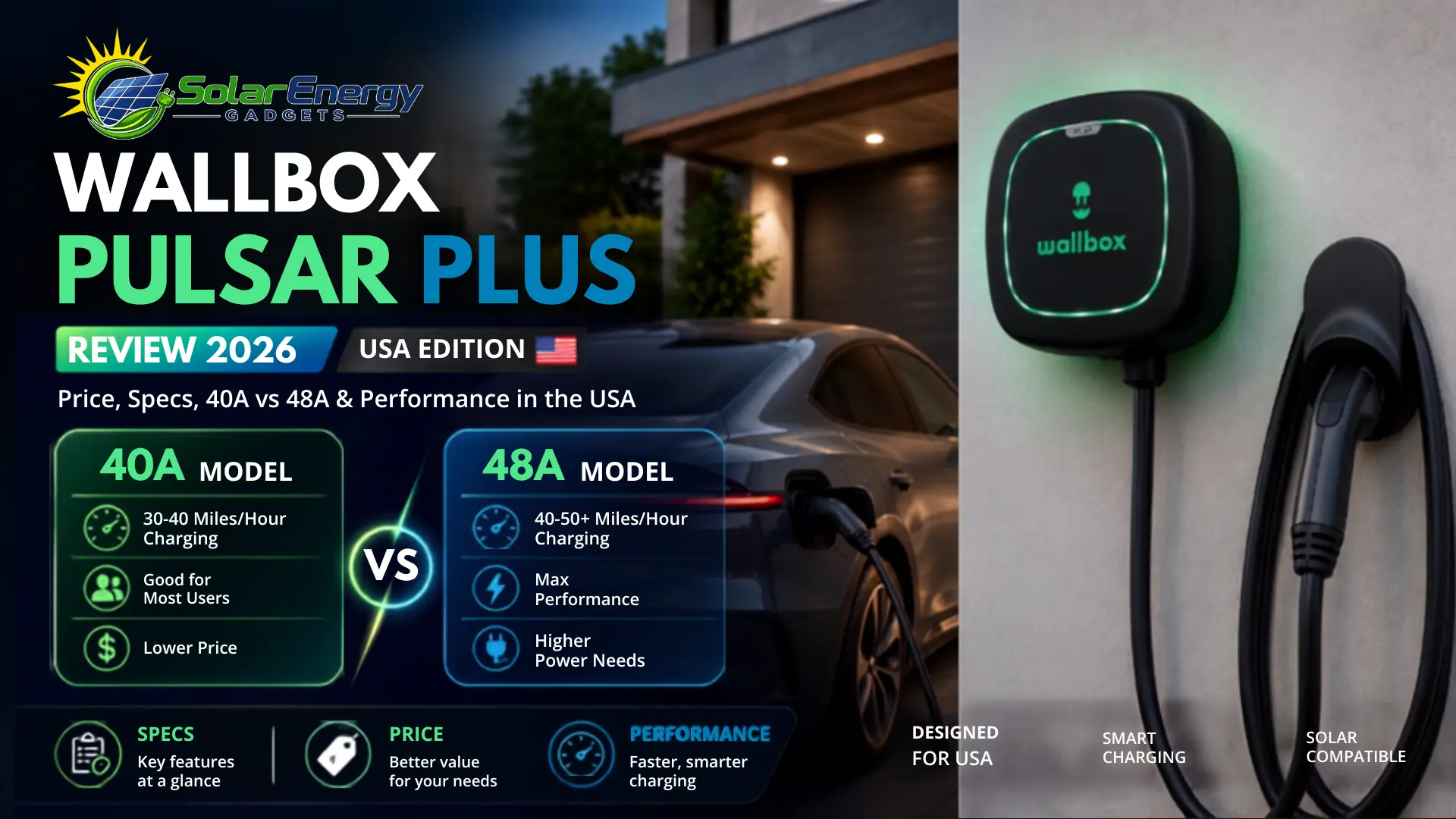
If you’re shopping for a Level 2 EV charger for your home, the Wallbox Pulsar Plus deserves a serious look. It combines a compact design with Wi-Fi and Bluetooth connectivity, app-based charging controls, energy management features, Power Sharing, and up to 11.5 kW of charging power.
But the Pulsar Plus isn’t automatically the best charger for every US homeowner.
Its biggest strengths are its compact size, smart charging features, outdoor-ready NEMA 4 enclosure, and flexible energy-management options. Its biggest drawbacks are its premium pricing and poor cable flexibility in extreme cold, according to independent testing by EnergySage’s EV charging expert Tom Moloughney.
In this Wallbox Pulsar Plus review, we’ll compare the 40A and 48A models, examine charging performance, installation requirements, smart features, US pricing, connector options, solar compatibility, pros and cons, and the alternatives worth considering before you buy.
Wallbox Pulsar Plus Review: Quick Verdict
Our verdict: Recommended for homeowners who want a compact, feature-rich smart EV charger and don’t live in an extremely cold climate.
The Pulsar Plus is particularly attractive if you want:
- A compact Level 2 home EV charger
- Wi-Fi and Bluetooth connectivity
- Smartphone charging controls
- Scheduled charging
- Energy monitoring
- Power Sharing for multiple chargers
- Indoor or outdoor installation
- Solar-energy integration with the appropriate Wallbox power meter
- J1772 or NACS connector options
Wallbox currently positions the Pulsar Plus as a US home charging solution with 40A and 48A options, up to 11.5 kW of charging power, and a starting price of $649.99.
Quick rating
| Category | Rating |
| Charging performance | 4.5/5 |
| Smart features | 4.5/5 |
| Design | 5/5 |
| App & connectivity | 4/5 |
| Outdoor capability | 4.5/5 |
| Installation flexibility | 4/5 |
| Value | 4/5 |
| Overall | 4.4/5 |
Best for: Smart-home users, two-EV households, solar owners, and buyers who value compact design.
Skip it if: You live somewhere with severe winters and regularly need to handle a very cold charging cable.
What Is the Wallbox Pulsar Plus?
The Wallbox Pulsar Plus is a smart Level 2 residential EV charger designed for faster home charging than a standard 120V Level 1 outlet.
In North America, the lineup includes 40A and 48A versions. The 40A model can use a NEMA 14-50 connection or be hardwired, while the 48A version is designed for hardwired installation. Both can deliver Level 2 charging at 240V and support smart connectivity through Wi-Fi and Bluetooth.
Wallbox also offers the Pulsar Plus with J1772 and NACS connector options, which is important for US buyers because NACS has become increasingly common across the North American EV market.
The charger’s compact enclosure is one of its defining characteristics. Instead of installing a large, bulky EVSE on your garage wall, the Pulsar Plus takes up relatively little space.
Wallbox Pulsar Plus 40 vs 48: What’s the Difference?
This is one of the most important decisions you’ll make before buying.
| Feature | Pulsar Plus 40 | Pulsar Plus 48 |
| Rated current | 40A | 48A |
| Maximum charging power | 9.6 kW | 11.5 kW |
| Installation | NEMA 14-50 or hardwired | Hardwired |
| Cable | 25 ft | 25 ft |
| Voltage | 240/208V | 240/208V |
| Connectivity | Wi-Fi + Bluetooth | Wi-Fi + Bluetooth |
| Indoor/outdoor | Yes | Yes |
| Environmental rating | NEMA 4 | NEMA 4 |
| Current configuration | 6A to rated current | 6A to rated current |
| Warranty | 3 years | 3 years |
Wallbox’s North American technical documentation confirms 9.6 kW for the 40A version and 11.5 kW for the 48A version. It also states that charging current can be configured from 6A up to the model’s rated current.
Which one should you buy?
Choose the Pulsar Plus 40 if:
- You already have a suitable NEMA 14-50 outlet.
- You want easier installation flexibility.
- 9.6 kW is sufficient for your EV.
- You want to keep the initial equipment cost lower.
Choose the Pulsar Plus 48 if:
- You want up to 11.5 kW.
- You’re installing a dedicated hardwired charger.
- Your EV can actually take advantage of the additional power.
- Your home’s electrical system can support the installation.
The important point is that a 48A charger doesn’t automatically mean your EV will charge at 48A. Your vehicle’s onboard AC charger determines how much power it can accept.
Wallbox Pulsar Plus Charging Speed
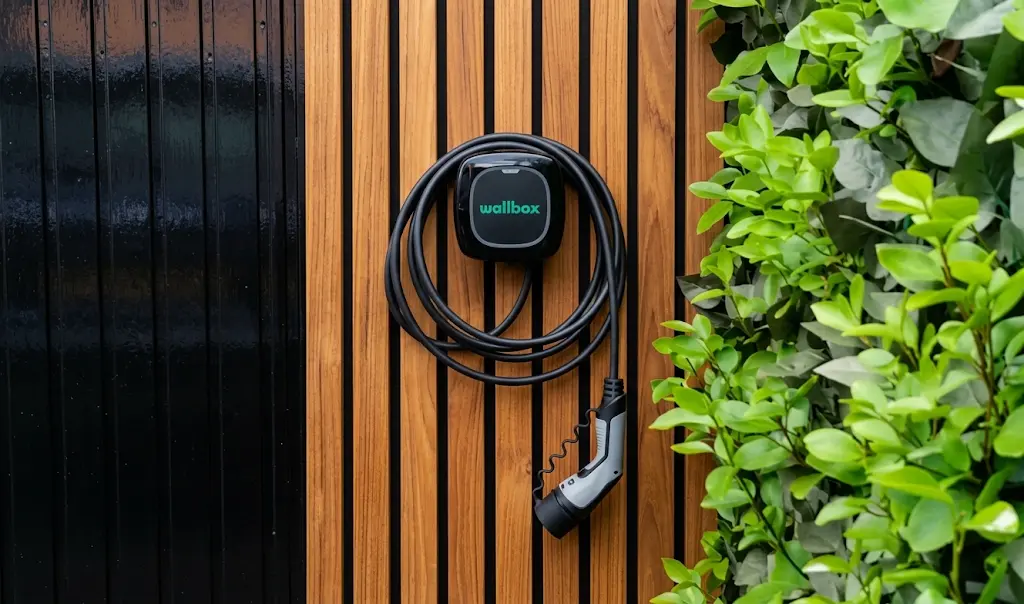
The Pulsar Plus is a Level 2 AC charger.
The 40A model provides up to 9.6 kW, while the 48A model provides up to 11.5 kW under the appropriate electrical conditions.
Wallbox advertises the Pulsar Plus as capable of charging up to eight times faster than a 120V outlet, although real-world charging time depends on your EV’s onboard charger, battery size, state of charge, temperature, and other factors.
Why your actual charging speed may be lower
Even if you install the 48A model, your EV may not accept the full 11.5 kW.
For example, if your vehicle’s onboard AC charger is limited below the charger’s maximum output, the car becomes the limiting factor.
That’s why you should check:
- Your EV’s maximum AC charging rate.
- Your home’s electrical capacity.
- Required circuit size.
- Whether you want plug-in or hardwired installation.
- Local electrical-code requirements.
Wallbox Pulsar Plus Smart Features
Smart functionality is one of the strongest reasons to consider the Pulsar Plus.
The charger connects through Wi-Fi and Bluetooth and works with the Wallbox app and portal. Wallbox’s documentation also lists features including smart Power Sharing and voice-control support.
- Scheduled Charging
You can schedule charging sessions around your preferred times.
For homeowners whose electricity rates vary by time of day, scheduled charging can help shift EV charging toward cheaper off-peak periods.
- Charging Monitoring
The Wallbox app can provide information about charging sessions and energy use, helping you understand how much electricity your EV is consuming.
- Remote Control
The smart platform allows users to manage charging remotely and control charging-related settings.
- Power Sharing
Power Sharing is particularly useful for households with multiple EVs.
Instead of requiring each charger to operate independently at maximum power, compatible Wallbox chargers can dynamically share available electrical capacity.
That can be valuable if you have two EVs but don’t want to dedicate maximum electrical capacity to both chargers simultaneously.
- Voice Control
Wallbox documentation lists compatibility with voice assistants including Amazon Alexa and Google Home.
Can the Wallbox Pulsar Plus Use Solar Power?
Yes, and this is especially interesting for solar-powered homes.
Wallbox says the Pulsar Plus can use surplus solar energy when paired with its Power Meter, enabling energy-management functionality between the home and EV charger.
This means a solar homeowner can potentially coordinate EV charging with household energy consumption rather than treating the EV charger as an isolated electrical load.
Why this matters
If your solar system frequently produces excess electricity during the day, charging an EV from that surplus can increase the amount of your solar generation that you consume yourself.
However, solar charging performance depends on:
- Solar system size
- Current solar production
- Household electricity demand
- EV charging requirements
- Battery storage, if installed
- Wallbox energy-management equipment
- Utility rate structure
So don’t assume every solar installation will automatically deliver solar-only EV charging.
Wallbox Pulsar Plus NACS vs J1772
US EV buyers should pay close attention to connector selection.
Wallbox currently offers Pulsar Plus configurations with J1772 and NACS connectors.
J1772
J1772 has historically been the common AC charging connector for many non-Tesla EVs in North America.
NACS
NACS has become increasingly important in the US market as more automakers adopt the connector.
Which connector should you choose?
Choose based on the vehicle or vehicles you currently own and what you expect to drive in the future.
If your household has multiple EVs with different connector requirements, connector compatibility should be one of the first things you evaluate.
Wallbox Pulsar Plus Specifications
Here are the key North American specifications from Wallbox documentation:
| Specification | Pulsar Plus |
| Model options | 40A / 48A |
| Maximum power | 9.6 kW / 11.5 kW |
| Rated voltage | 240/208V AC |
| Frequency | 60Hz |
| Cable length | 25 ft |
| Connector | J1772 or NACS options |
| Connectivity | Wi-Fi + Bluetooth |
| Installation | NEMA 14-50 or hardwired, depending on model/configuration |
| Current configuration | 6A to rated current |
| Indoor/outdoor | Yes |
| Environmental rating | NEMA 4 |
| Electrical safety | UL 2594, UL 2231 |
| Warranty | 3 years |
| App | Wallbox app / myWallbox platform |
Wallbox’s technical documentation lists NEMA Type 4 protection for indoor and outdoor installation, along with UL 2594 and UL 2231 electrical-safety standards.
Prefer video? Watch the full video here: Wallbox Pulsar Plus 40A vs 48A USA — Full Review & Installation Guide 2026
Wallbox Pulsar Plus Installation
Installation requirements depend on the model and your home’s existing electrical infrastructure.
The Pulsar Plus 40 can be configured for NEMA 14-50 plug-in installation or hardwiring, while the 48A model is hardwired.
Before installation, check:
- Electrical panel capacity
Your electrician needs to determine whether your existing panel can safely support the EV charger.
- Circuit requirements
The charger needs an appropriate dedicated circuit and protection based on the installation configuration and applicable electrical codes.
- Cable distance
The distance between your electrical panel and parking location can significantly affect installation cost.
- Indoor vs outdoor location
The NEMA 4 enclosure allows indoor or outdoor installation, but the installation still needs to comply with local requirements.
- Permit requirements
Electrical permit requirements vary by jurisdiction.
How much does installation cost?
There isn’t one universal US installation price.
Your final cost can depend on:
- Panel capacity
- Wiring distance
- Labor rates
- Existing outlet
- Conduit requirements
- Electrical upgrades
- Permits
- Location of the charger
As a useful independent benchmark, EnergySage’s 2026 review says EV charger installation typically adds approximately 800–3,000, depending on the home’s electrical setup.
Always get a quote from a licensed electrician before budgeting for the complete installation.
Is the Wallbox Pulsar Plus Good for Outdoor Installation?
Yes.
The North American Pulsar Plus is rated NEMA 4, and Wallbox specifies it for indoor and outdoor installation.
This is an important advantage if you need to install your charger:
- On an exterior garage wall
- On a driveway
- Under a suitable outdoor structure
- In a location exposed to rain
Independent testing by EnergySage also found that the NEMA 4 enclosure performed well during a heavy-water test of the Pulsar Plus 48.
However, outdoor installation doesn’t mean every climate is equally suitable.
Wallbox Pulsar Plus Cold Weather Performance
This is probably the biggest warning we would give potential buyers.
EnergySage’s 2026 testing found significant problems with cable flexibility during extreme cold. Its testing reported that the Pulsar Plus 40 cable became extremely rigid at -13°F, while the Pulsar Plus 48 performed poorly after an overnight freeze at -5°F.
For buyers in northern US states, this deserves serious consideration.
Our takeaway
If you live in a mild or moderate climate, this may not be a major issue.
If your garage or outdoor charger regularly experiences freezing temperatures, look closely at alternatives before buying.
This is a perfect example of why product specifications alone don’t tell the entire story.
Wallbox Pulsar Plus Price
Pricing changes based on:
- Model
- Connector
- Retailer
- Promotions
- Accessories
- Power meter
- Enclosure
- Installation
Wallbox’s current US store lists the Pulsar Plus J1772 40A model at $649.99, while its product lineup also includes NACS versions and configurations with additional energy-management equipment.
EnergySage’s April 2026 review lists the Pulsar Plus 40 at $749 and the Pulsar Plus 48 at $800, illustrating why buyers should check the current price before purchasing.
Don’t forget installation
The charger price is only part of your total cost.
Your actual project cost is:
Charger + electrical work + permits + accessories + installation
That’s the number you should compare against competing chargers.
Wallbox Pulsar Plus vs ChargePoint Home Flex
The ChargePoint Home Flex is one of the most obvious alternatives to the Pulsar Plus.
| Feature | Wallbox Pulsar Plus | ChargePoint Home Flex |
| Maximum power | Up to 11.5 kW | Up to 12 kW |
| Rated current | Up to 48A | Up to 50A |
| Connectivity | Wi-Fi + Bluetooth | Wi-Fi |
| Smart app | Yes | Yes |
| Power Sharing | Yes | No equivalent multi-charger feature |
| Installation | Plug-in/hardwired depending on model | Plug-in/hardwired |
| Outdoor use | NEMA 4 | Outdoor capable |
| Connector options | J1772/NACS configurations | J1772/NACS configurations |
| Main strength | Compact design + smart energy features | Flexible charging + established ecosystem |
| Main concern | Premium price + cold-weather cable performance | Depends on configuration and current pricing |
EnergySage’s 2026 independent testing placed the Pulsar Plus below several competing chargers on its ChargerRater scoring system, while still highlighting its smart features and compact design.
Which one should you choose?
Choose Wallbox Pulsar Plus if:
- You want a compact charger.
- You value Wi-Fi and Bluetooth.
- You want Power Sharing.
- You want solar-energy integration options.
- You like the Wallbox app ecosystem.
Consider ChargePoint Home Flex if:
- You want a highly established home-charging brand.
- You want flexible amperage.
- You prioritize charging flexibility over the Pulsar Plus’s compact design.
Wallbox Pulsar Plus: Pros and Cons
Pros
- Compact design
- Up to 11.5 kW charging
- 40A and 48A options
- NEMA 14-50 option on the appropriate model
- Hardwired installation option
- Wi-Fi connectivity
- Bluetooth connectivity
- Wallbox mobile app
- Scheduled charging
- Energy monitoring
- Power Sharing
- Solar-energy integration with Power Meter
- NEMA 4 outdoor protection
- 25-foot cable
- 3-year warranty
- J1772 and NACS configurations available
Wallbox’s current product information confirms the smart app, solar-energy, and warranty features.
Cons
- Premium pricing compared with some competitors
- Cold-weather cable performance is a significant concern
- 48A installation requires hardwiring
- Installation can become expensive if your electrical panel needs upgrades
- The highest charging rate may exceed what some EVs can actually accept
Who Should Buy the Wallbox Pulsar Plus?
Best for smart-home users
If you want to control and monitor your EV charger through an app, the Pulsar Plus is a strong candidate.
Best for two-EV households
Power Sharing makes the Pulsar Plus particularly interesting for homes with multiple EVs.
Best for solar homeowners
The ability to integrate with Wallbox’s energy-management equipment makes it worth considering for solar-powered homes.
Best for compact installations
The small enclosure is one of the most appealing characteristics of the Pulsar Plus.
Best for mild-to-moderate climates
If you don’t regularly deal with extreme freezing temperatures, the cable issue identified during independent testing may be less important.
Who Should Avoid the Wallbox Pulsar Plus?
You may want to consider alternatives if:
You live in an extremely cold climate
Independent testing identified substantial cable stiffness at sub-zero temperatures.
You want the lowest possible price
The Pulsar Plus carries a premium compared with some competitors.
Your electrical panel is limited
Before choosing a 40A or 48A charger, have an electrician evaluate your electrical capacity.
Your EV can’t use the charger’s maximum output
A more powerful charger doesn’t necessarily provide faster charging if your vehicle’s onboard charger is the limiting factor.
Wallbox Pulsar Plus Reliability and Real-World Performance
Specifications tell only part of the story.
EnergySage’s 2026 review tested both Pulsar Plus models using Tom Moloughney’s ChargerRater evaluation system. The Pulsar Plus 40 scored 82/100, while the Pulsar Plus 48 scored 81/100.
The testing highlighted several strengths:
- Strong smart features
- Compact design
- Good weather protection
- Power Sharing
But it also identified:
- Cold-weather cable problems
- Premium pricing
- Value concerns compared with some competing chargers
This is why we wouldn’t call the Pulsar Plus a universal “best EV charger.”
Instead, we’d call it a strong specialist option for the right homeowner.
Wallbox Pulsar Plus Warranty
Wallbox currently advertises a 3-year warranty for the Pulsar Plus.
Before purchasing, always check the current warranty terms for your exact configuration and market because warranty coverage can depend on product version and installation requirements.
Is Wallbox Pulsar Plus Worth It?
For the right homeowner, yes.
The Pulsar Plus isn’t competing purely on charging power. There are other Level 2 chargers that can match or exceed its output.
Instead, Wallbox’s proposition is:
Compact design + smart charging + connectivity + energy management + Power Sharing.
That’s a compelling combination.
But the premium price means you should compare it against alternatives before buying.
And if you live in a region where winter temperatures regularly fall well below freezing, the cable-performance results from independent testing are a legitimate reason to consider another charger.
Our Wallbox Pulsar Plus Rating
| Category | Rating |
| Charging performance | 4.5/5 |
| Smart features | 4.5/5 |
| Design | 5/5 |
| App & connectivity | 4/5 |
| Outdoor capability | 4.5/5 |
| Solar integration | 4.5/5 |
| Installation flexibility | 4/5 |
| Value for money | 4/5 |
| Cold-weather performance | 2.5/5 |
| Overall | 4.4/5 |
Final verdict
Recommended — with climate and pricing caveats.
The Wallbox Pulsar Plus is one of the more interesting smart Level 2 EV chargers for US homeowners who care about compact design, app control, Power Sharing, and energy management.
Its 40A and 48A configurations give buyers options, while NEMA 4 protection makes it suitable for indoor and outdoor installations. Solar owners can also pair it with Wallbox’s Power Meter for energy-management features.
However, the price is higher than some competing chargers, and independent testing found serious cable-flexibility problems in extreme cold.
Our recommendation: If you live in a mild climate and want a compact, smart charger with strong energy-management capabilities, the Pulsar Plus is worth considering. If you’re in a very cold region or want maximum value, compare it with alternatives before buying.
Frequently Asked Questions on Wallbox Pulsar Plus USA
Is the Wallbox Pulsar Plus a good EV charger?
Yes. The Pulsar Plus is a strong smart Level 2 charger for homeowners who value compact design, app control, Wi-Fi, Bluetooth, Power Sharing, and energy-management features. Its main drawbacks are premium pricing and poor cable flexibility in extreme cold.
How fast is the Wallbox Pulsar Plus?
The Pulsar Plus 40 provides up to 9.6 kW, while the Pulsar Plus 48 provides up to 11.5 kW under suitable electrical conditions.
What is the difference between Wallbox Pulsar Plus 40 and 48?
The main differences are rated current, maximum power, and installation. The 40A version delivers up to 9.6 kW and can use NEMA 14-50 or a hardwired installation, while the 48A version delivers up to 11.5 kW and is hardwired.
Does the Wallbox Pulsar Plus work with Tesla?
Wallbox currently offers Pulsar Plus configurations with NACS connectors as well as J1772 versions. Check the exact connector configuration before purchasing for your Tesla or other EV.
Does Wallbox Pulsar Plus support solar charging?
Yes. Wallbox says the Pulsar Plus can use surplus solar energy when paired with its Power Meter and appropriate energy-management functionality.
Is the Wallbox Pulsar Plus waterproof?
The North American Pulsar Plus has a NEMA 4 environmental rating and is designed for indoor and outdoor installation.
Does the Wallbox Pulsar Plus work in cold weather?
It can operate within the manufacturer’s specified temperature range, but independent testing found significant cable-flexibility problems in extreme cold. This is an important consideration for homeowners in very cold US climates.
How much does the Wallbox Pulsar Plus cost?
Pricing varies by model, connector, and configuration. Wallbox’s US store currently lists the Pulsar Plus 40 J1772 at $649.99, while other configurations and accessories cost more.
Does the Wallbox Pulsar Plus require an electrician?
Installation requirements depend on the model and your existing electrical setup. The 48A version is hardwired, while the 40A version can use a NEMA 14-50 connection or be hardwired. Electrical installation should comply with local codes and be evaluated by a qualified professional.
Does Wallbox Pulsar Plus support Power Sharing?
Yes. Power Sharing allows compatible Wallbox chargers to dynamically share available electrical capacity between charging vehicles.
How long is the Wallbox Pulsar Plus cable?
The North American Pulsar Plus uses a 25-foot cable.
Final Recommendation
The Wallbox Pulsar Plus isn’t the cheapest Level 2 EV charger, and it isn’t the best choice for every climate.
But for a US homeowner looking for a compact, connected, energy-aware home EV charger, it offers a compelling mix of features.
Buy it if: You want smart charging, compact design, Power Sharing, and solar-energy integration.
Think twice if: You live in an extremely cold climate or want the absolute lowest cost per amp.
Our overall rating: 4.4/5
Related EV Charging Guides
- Best Level 2 EV Chargers in 2026
- Wallbox Pulsar Plus 40 vs 48
- Wallbox Pulsar Plus vs ChargePoint Home Flex
- Best EV Chargers for Two-EV Households
- Best NACS Home EV Chargers
- Best EV Chargers for Solar Homes
- EV Charger Installation Cost in the US
- J1772 vs NACS: What’s the Difference?
Editorial & Review Disclosure
Solar Energy Gadgets provides independent product research, reviews, and buying guides for US consumers. Product specifications, pricing, and availability can change, so readers should verify current information with the manufacturer or retailer before purchasing.
Some links on Solar Energy Gadgets may be affiliate links. We may earn a commission when a reader makes a qualifying purchase. Affiliate relationships do not determine our editorial ratings or conclusions.
Where we rely on independent testing, we identify the external source rather than presenting that testing as our own hands-on experience.

Solar Energy Gadgets is a premier global hub for original, expert-led solar product reviews. Our dedicated team of specialists rigorously tests the latest renewable energy technology from around the world to ensure our readers receive unbiased and practical advice. Whether you are outfitting a suburban home or looking for the best off-grid gear, we provide the insights you need to harness the power of the sun with confidence.