If you’re shopping for a home EV charger and you keep landing on the same product, there’s a reason: the Tesla Universal Wall Connector, also known as the Tesla Home Charger, has become the default recommendation for mixed-EV households across North America. It’s not just for Tesla owners anymore — and that’s the entire point of the “universal” name.
This guide covers everything you need before buying: full Tesla universal wall connector spec sheet details, real technical and additional features, an honest look at benefits, and a country-by-country price breakdown for the USA, UK, Australia, and Canada.
What Is the Tesla Universal Wall Connector?
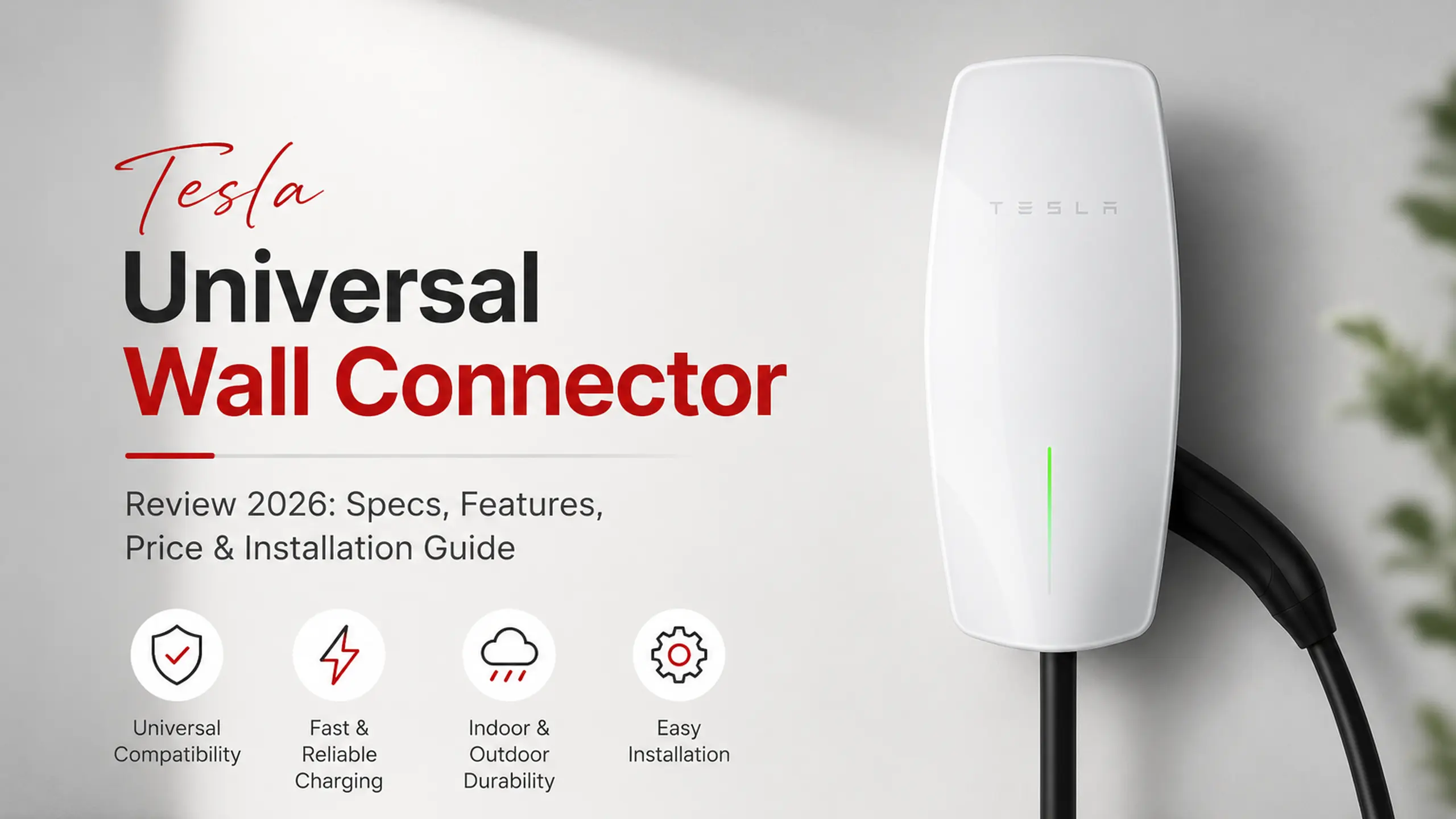
The Tesla universal wall connector is Tesla’s Level 2 home charging station built to charge any electric vehicle sold in North America — not just Teslas. It does this through an integrated Magic Dock system that pairs a NACS (North American Charging Standard) connector with a docked J1772 adapter. Plug in a Tesla directly with the NACS cable, or pop the J1772 adapter off its dock to charge a Ford, GM, Rivian, or any other J1772-compatible EV.
It replaced the need to buy a separate adapter or a third-party charger for households running more than one EV brand — which is increasingly common as more automakers adopt NACS as their standard port.
Important regional note: the dual NACS/J1772 “Universal” version is specific to the USA and Canada, where J1772 has historically been the non-Tesla standard. In the UK and Australia, Tesla sells the equivalent Tesla Wall Connector with a Type 2 connector instead, since that’s the regional standard. Functionally, they serve the same purpose — universal home charging — just with the connector type matched to the local market.
Tesla Universal Wall Connector: Full Specifications
Here’s the complete Tesla universal wall connector spec sheet, based on Tesla’s official documentation:
| Spec | Detail |
| Charger type | Level 2, AC home charging |
| Max output | 11.5 kW / 48 amps (North America) |
| Connector | Integrated NACS + docked J1772 adapter |
| Range added | Up to 44 miles/hour (Tesla vehicles), up to 30 miles/hour on 32A-limited models |
| Cable length | 24 feet (7.3 m) |
| Connectivity | Wi-Fi, over-the-air firmware updates |
| App control | Tesla app — scheduling, monitoring, remote diagnostics |
| Mounting | Indoor/outdoor rated |
| Backup power | Powershare-compatible (Cybertruck only, currently) |
| Warranty | 4 years, residential use |
| Installation | Hardwired, requires a licensed/certified electrician |
For non-North American markets, the equivalent Tesla Wall Connector (Type 2) delivers up to 22 kW on three-phase power or 7.4 kW on single-phase, which is the standard most UK and Australian homes will actually see in practice.
Technical Features That Matter
Beyond the raw numbers, a few technical details are worth understanding before you commit:
- Power Management / Dynamic Load Management — the charger can automatically scale its output down to fit within your home’s existing electrical capacity, which can mean the difference between needing a costly panel upgrade or not.
- Auto-sensing handle — automatically pops open the charge port on Tesla vehicles when you grab the connector.
- Adjustable amperage — configurable at 48A, 40A, 32A, 24A, 16A, or 12A depending on your circuit and panel.
- Wi-Fi firmware updates — the unit improves over time without a technician visit.
- UL-approved (US) / IP55-rated build — rated for genuine outdoor exposure, not just covered carports.
Additional Features
A few extras separate this from a bare-bones Level 2 charger:
- Multi-vehicle scheduling through the Tesla app, useful for time-of-use electricity rates
- Remote diagnostics, so issues can often be identified without an in-person callout
- Powershare integration for Cybertruck owners, enabling home backup power during outages
- No loose adapters — the J1772 adapter locks into a dock on the unit itself, so it can’t be misplaced
Tesla Wall Connector vs Universal Wall Connector
This is one of the most-searched comparisons, and the answer is simple:
- Tesla Wall Connector — NACS-only, best if every EV in your household is a Tesla
- Tesla Universal Wall Connector — NACS + J1772, best for mixed-EV or future-proofed households
Given how narrow the price gap between the two has become in most markets, most reviewers now recommend the Universal version by default, even for single-Tesla households, simply for the resale and flexibility value if a second, non-Tesla EV joins the household later.
Tesla Universal Wall Connector Installation
The unit is not a plug-and-play product — it’s hardwired and must be installed by a licensed electrician. A typical Tesla universal wall connector installation involves:
- An electrical load assessment of your home panel
- Running a dedicated circuit (typically 60A for full 48A output)
- Mounting the unit indoors or outdoors near your parking spot
- Wi-Fi setup and pairing through the Tesla app
Tesla maintains a network of Certified Installers in the US, UK, Australia, and Canada who can quote installation separately from the unit price. Installation costs typically run:
- USA: $300–$1,500+ depending on panel capacity
- UK: £400–£600
- Australia: AUD $750–$1,500 (single vs three-phase runs vary this significantly)
- Canada: CAD $500–$1,200+, more if a panel upgrade is required
If you ever need the printed reference, the Tesla Universal Wall Connector manual is available directly from Tesla’s support site (linked below) and covers wiring diagrams, amperage configuration, and troubleshooting.
Benefits for Users
Why this charger consistently ranks as a top pick in Tesla universal wall connector reviews:
- True cross-brand compatibility — one charger works for every EV in a multi-car household
- Faster home charging than any public Level 1 outlet or most competitors at this price point
- App-based control — no separate hardware app to learn
- Backed by Tesla’s install network — thousands of certified installers across all four markets
- Strong resale/property value — a hardwired, branded charger is viewed favorably by future EV-owning buyers
- Solid 4-year warranty, ahead of many budget competitors
Tesla Universal Wall Connector Prices: USA, UK, Australia, Canada
Pricing on this unit moves fairly often, so treat these as a current snapshot rather than a fixed number — always confirm on Tesla’s official shop before buying.
| Country | Unit Price (approx.) | Typical Installed Total |
| USA | $570–$650 USD | $900–$2,000+ |
| UK (Type 2 Wall Connector) | £475 | £875–£1,075 |
| Australia (Type 2 Wall Connector) | AUD $750–$800 | AUD $1,500–$2,500 |
| Canada | CAD $785–$860 | CAD $1,300–$2,000+ |
| Other markets (e.g., Malaysia, UAE, EU) | Sold via Tesla’s regional shop, priced in local currency | Varies by installer network |
For markets outside these four, Tesla’s shop auto-detects your region (shop.tesla.com) and displays local currency pricing and available installer support.
Tesla Universal Wall Connector: Product Info and Reviews Summary
Across independent Tesla universal wall connector product info and reviews, the consensus is consistent: it’s the most convenient home charger for anyone who isn’t a single-brand-only Tesla household, and it remains competitively priced against third-party Level 2 chargers with similar output — even without the cross-compatibility.
The main criticisms that show up repeatedly:
- No built-in smart tariff scheduling (it only knows what your car and the Tesla app tell it)
- Requires professional installation, adding to the total cost
- Powershare is currently limited to the Cybertruck
Real-World Use Cases
Specs only tell half the story. Here’s how the Tesla universal wall connector actually performs in the situations people buy it for:
- The mixed-EV garage. This is the charger’s core use case. A household with a Tesla Model Y and, say, a Ford Mustang Mach-E no longer needs two chargers or a loose third-party adapter. One hardwired unit handles both vehicles through the Tesla app, with charging history tracked per vehicle.
- Multi-unit and shared driveways Because the J1772 adapter locks into its dock when not in use, the connector holds up well in shared-access situations — townhomes, duplexes, or driveways used by more than one EV owner — without adapters going missing.
- Solar-paired home charging: Homes running solar with battery storage frequently pair this charger with their system to shift EV charging to daylight or off-peak battery hours, using the Tesla app’s scheduling to avoid pulling from the grid during peak-rate windows.
- Overnight top-ups for daily commuters. At full 48A output, a typical commuter EV goes from a partial charge to full range overnight — well within the charger’s 11.5 kW ceiling, even on a single circuit.
- Backup power readiness (Cybertruck households): For Cybertruck owners, the Powershare integration turns the wall connector into part of a home backup power setup during outages — a use case that’s expanding as Tesla rolls Powershare support out to more vehicles.
Verified Reviews: Amazon, Best Buy & Official Sources
Rather than relying on marketing copy, here’s what verified buyers are actually reporting on major retail platforms.
Amazon (4.6/5 average, 350+ ratings) A verified purchaser who reported installing over 200 units professionally noted zero issues across installs and confirmed compatibility across Tesla and non-Tesla EVs alike — a strong signal for anyone worried about real-world Tesla universal wall connector installation reliability.
Best Buy (verified purchases) Reviewers consistently highlight three things: build quality, ease of installation, and charging speed. One buyer described the process of permitting and installation as finished in under a week from a local Best Buy purchase, with the unit working flawlessly since. Best Buy’s own review summary notes that customer sentiment centers on strong performance and design, with occasional concerns raised about price and the J1772 adapter’s fit.
Independent editorial reviews Long-form reviewers have called it the most versatile home charger currently available, citing ease of use and design as standout strengths relative to competitors at a similar price.
Common critical feedback worth knowing before you buy:
- A minority of owners report the J1772 adapter needing a firm, deliberate connection with certain non-Tesla EVs
- Some buyers flag that panel upgrades — where required — add meaningfully to total installed cost
- A few reviewers wish for more granular access controls (e.g., NFC-based charge authorization)
Taken together, the verified review pattern across Amazon and Best Buy lines up with what the specs promise: strong, reliable Level 2 charging, with the adapter fit being the one recurring point of friction for non-Tesla vehicles.
Conclusion
The Tesla Universal Wall Connector earns its reputation as one of the most dependable home EV chargers available today — fast, app-connected, and genuinely cross-compatible in a way few competitors match — backed by consistently strong verified reviews on Amazon and Best Buy.
This review was researched and written by the team at Solar Energy Gadgets, where we cover solar products, EV charging solutions, and home energy gear to help readers make informed buying decisions. If you’re building out a solar-plus-EV setup at home, explore more of our in-depth reviews and buying guides on the site.
Frequently Asked Questions on Tesla Home Charger
What is the difference between the Tesla Wall Connector and the Universal Wall Connector?
The standard Tesla Wall Connector uses a Tesla-only NACS plug, while the Tesla Wall Connector vs. Universal Wall Connector comparison comes down to one thing: the Universal version adds a docked J1772 adapter, letting it charge any EV that uses that connector standard. Both deliver the same charging speeds — the difference is compatibility, not performance.
How fast does the Tesla Universal Wall Connector charge?
At full output (11.5 kW / 48A), it adds up to 44 miles of range per hour for Tesla vehicles. Actual speed depends on your vehicle’s onboard charger — some models are capped lower, such as certain Model 3 and Model Y trims limited to 32A.
Do I need a 60-amp circuit for installation?
For full 48A output, yes — Tesla recommends a dedicated 60-amp circuit. The charger’s Power Management feature can scale output down for homes with lower panel capacity, avoiding a full panel upgrade in many cases.
Can I install the Tesla Universal Wall Connector myself?
No. It’s a hardwired unit and must be installed by a licensed electrician — ideally one from Tesla’s Certified Installer network — to meet local electrical code and preserve the warranty.
Is the Tesla Universal Wall Connector compatible with non-Tesla EVs?
Yes. That’s the core feature of the Tesla universal wall connector EV charger — the built-in J1772 adapter lets it charge Ford, GM, Rivian, and any other EV using a J1772 or NACS port, no separate adapter purchase needed.
Where can I find the official Tesla Universal Wall Connector manual?
The Tesla Universal Wall Connector manual is available directly on Tesla’s support site, covering wiring specs, amperage configuration, and troubleshooting steps for installers and owners.
How much does the Tesla Universal Wall Connector cost installed?
Unit pricing typically runs $570–$650 USD, with installed totals (including electrician labor and any panel work) ranging from roughly $900 to $2,000+ depending on your home’s existing electrical setup.
Is the Universal Wall Connector worth it over the standard Wall Connector?
For most buyers, yes — especially given how narrow the price gap has become. Even Tesla-only households often future-proof with the Universal version in case a second, non-Tesla EV joins the garage later.
Does the Tesla Universal Wall Connector work outdoors?
Yes, it’s rated for both indoor and outdoor installation, built to handle regular weather exposure at a typical home charging location.
What do verified Amazon and Best Buy reviews say about reliability?
Reviews are strongly positive, averaging 4.6/5 on Amazon. Verified buyers highlight easy installation, consistent charging performance, and solid build quality, with the J1772 adapter fit being the most common minor complaint among non-Tesla EV owners.
Can the Tesla Universal Wall Connector power my home during an outage?
Only in combination with Tesla’s PowerShare technology, which is currently available for Cybertruck owners. Support for additional vehicles is expected to expand over time.

Solar Energy Gadgets is a premier global hub for original, expert-led solar product reviews. Our dedicated team of specialists rigorously tests the latest renewable energy technology from around the world to ensure our readers receive unbiased and practical advice. Whether you are outfitting a suburban home or looking for the best off-grid gear, we provide the insights you need to harness the power of the sun with confidence.