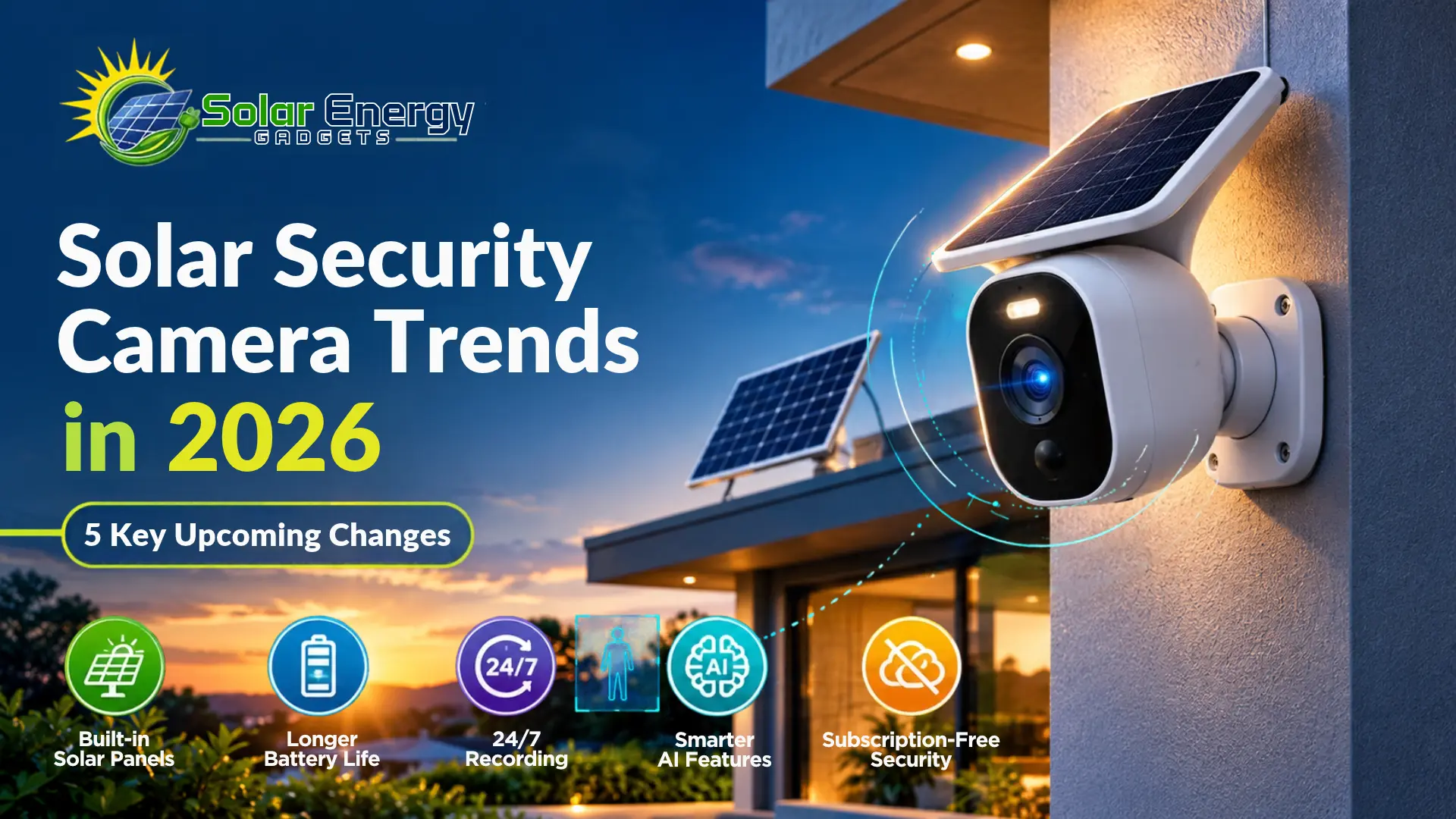
Solar security cameras are evolving rapidly in 2026. What once required a separate solar panel, extra wiring, and regular battery charging is becoming simpler, with manufacturers introducing integrated solar panels, larger batteries, smarter tracking, and more flexible recording options.
Arlo’s Essential Solar Security Camera, announced on September 29, 2026, highlights this shift. But Arlo is not alone: Reolink, eufy, TP-Link, and Uniden are also pushing solar-powered security cameras in new directions.
In this guide, we’ll explore five key solar security camera trends in 2026, compare the latest models, and explain what these changes mean for homeowners, renters, and people securing off-grid properties.
What Arlo Just Launched
Arlo’s Essential Solar Security Camera is its first camera with a built-in solar panel. The specs:
- Power: a 1.2W integrated panel and a 14,790mAh battery. Arlo says two hours of sun a day keeps it running, and a full battery can last up to six months with no sun at all.
- Video: 2K at 24 fps, a 130° field of view, color night vision with a spotlight, and two-way audio.
- Durability and extras: IP65 weather resistance, a built-in siren, and dual-band Wi-Fi. It works with Alexa, Google Home, IFTTT, and SmartThings.
- Price: The launch announcement lists $99.99, with preorders opening in September and shipping scheduled for mid-October.
Live view and basic motion alerts work without a subscription. The AI features (threat assessment, event captions, summaries) need an Arlo Secure plan. Arlo’s own battery claims come with a note that real-world life depends on settings, activity, and environment.
It isn’t alone. Here is the 2026 field.
The 2026 Solar Camera Launches at a Glance
| Camera | Panel | Battery | Standout feature | Price |
| Arlo Essential Solar | 1.2W, built-in | 14,790mAh | Up to 6 months without sun (claimed) | $99.99 at launch |
| Reolink OMVI 2i Ultra | 6W, built-in | 10,000mAh, detachable | Dual lens (8MP + 5MP pan-tilt) with SyncTrack | Est. $200–250 (US) |
| eufy Wall Light Cam S4 | 2W, detachable | 10,000mAh | 4K camera combined with a wall light | $249.99 on eufy’s store |
| TP-Link Tapo C660 KIT | Separate panel | 10,000mAh | 4K with 360° pan-tilt tracking | See note below |
| Uniden SOLO X2K PT Pro | Included panel | 10,400mAh | 24/7 continuous recording | A$279.95 |
Note:Tapo C660 and Uniden SOLO X2K were launched in Australia; confirm US availability and pricing before listing them.
Trend 1: Solar Is Now Built In
For years, solar meant a bolt-on panel. Arlo’s design puts the panel on top of the camera. The upside is simplicity: no extra cable and nothing to mount separately. The downside is placement, because the camera has to sit where the sun is, not just where the view is best.
Other brands are going the opposite way. eufy’s S4 has a detachable panel that can sit up to about six feet from the camera, and TP-Link’s C660 offers a separate panel on a 3.8-meter cable. Expect “integrated vs. detachable” to become a standard buying question.
Trend 2: Big Battery or Big Panel?
The launches show two strategies. Arlo pairs a small 1.2W panel with a very large battery. Reolink goes the other way with a 6W panel and says its SolarEase tech improves charging efficiency by 26%, so about 30 minutes of daily sun is enough. TP-Link’s press release says 45 minutes of direct sun can run the camera all day under standard test conditions.
“Months without sun” is now a headline spec. Reolink claims six months for the OMVI 2i Ultra, while eufy rates the S4 at around two months. These are manufacturer claims, so shade, cold weather, and event frequency will change them in real use.
Trend 3: Always-On Recording Is Arriving
Traditional battery cameras record short clips when they detect motion. That is starting to change. Uniden’s OnWatch technology records 24/7 on solar, and TP-Link’s C660 keeps a low-frame-rate background recording going, then switches to full quality when it sees motion.
There’s a catch: storage. One Australian retailer notes the included 32GB card holds only about 24–48 hours of continuous 2K footage, so buyers will need bigger cards.
Trend 4: Dual Lenses and Smarter Tracking
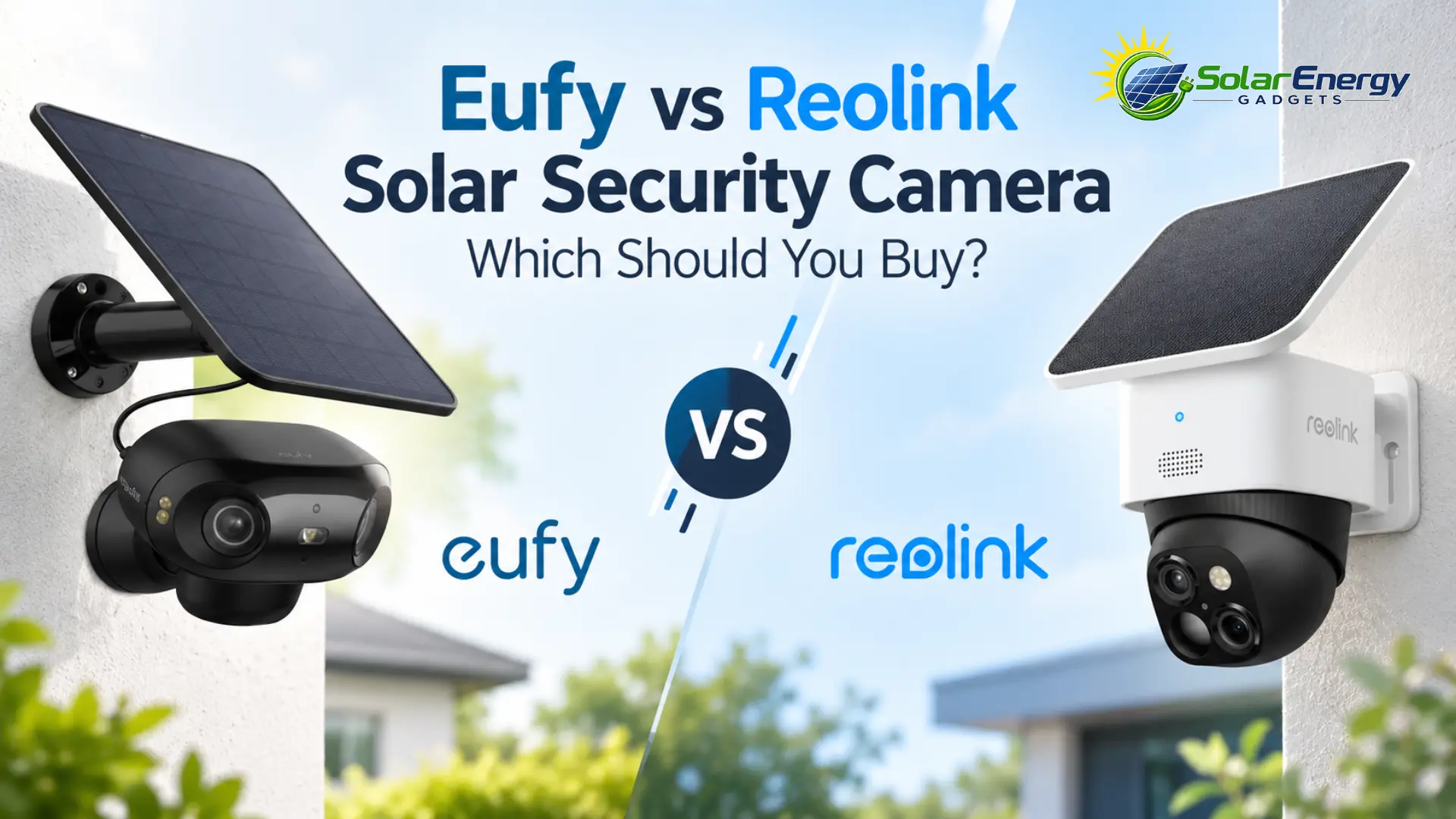
Reolink’s OMVI 2i Ultra pairs a fixed wide-angle camera with a motorized pan-tilt camera. When the wide lens spots something, the second lens follows it, even after it leaves the wide view. eufy’s S4 also uses two cameras with radar-triggered recording. A single fixed lens is starting to look like the basic option.
Trend 5: The Subscription Question
Brands are splitting into two camps. Arlo uses a free baseline with paid AI features. Reolink is pushing subscription-free on-device AI (ReoNeura), and eufy’s S4 includes 32GB of built-in storage, so event clips need no plan. As solar removes the charging chore, the ongoing cost becomes the main difference between brands.
What to Watch Next
These are my takeaways from the launch pattern, not confirmed roadmaps:
- Price compression. A solar camera at $99.99 puts pressure on the 150–250 tier. Watch whether rivals match it or compete on AI and storage.
- Hybrid fixtures. eufy’s wall-light camera hints that solar cameras may merge with lighting, floodlights and doorbells.
- Off-grid connectivity. 4G models like Uniden’s SOLO X2K 4G Pro suit farms, caravans and construction sites, a category that barely existed a few years ago.
- Real-world proof. Most runtime claims are still lab or manufacturer figures. Independent winter testing will decide which claims hold up.
Solar Security camera comparison
| Camera | Solar setup | Main advantage | Price and market |
| Arlo Essential Solar | Integrated panel | Large claimed battery reserve | US$99.99 launch MSRP; US |
| Reolink OMVI 2i Ultra | Integrated 6W panel | Dual-view tracking | Estimated US$200–250; US launch pricing |
| eufy Wall Light Cam S4 | Detachable 2W panel | 4K security camera with lighting | US$249.99 listed price; US |
| TP-Link Tapo C660 KIT | Separate panel | 4K, pan-tilt tracking and 24/7 Capture | Australian availability; verify local price |
| Uniden SOLO X2K PT Pro | Included solar panel | 24/7 recording | A$279.95 listed price; Australia |
Should You Wait or Buy Now?
If you want a simple, low-cost camera with the fewest wires, Arlo’s integrated design is worth watching once reviews arrive. If your best camera spot is shaded, a detachable-panel model gives you more placement freedom. If you want to avoid monthly fees, compare the subscription-free options first.
Frequently Asked Questions
Do solar security cameras work without direct sunlight?
Yes. A solar security camera can continue operating using energy stored in its battery, even when direct sunlight is unavailable. However, prolonged shade or cloudy weather can reduce charging and eventually require manual charging, depending on battery capacity and power consumption.
Are solar security cameras worth buying in 2026?
They can be a good choice for outdoor locations where running power cables is difficult. They can reduce manual charging and simplify installation, but performance depends on sunlight, camera activity, network connectivity, and the model’s charging system.
Do solar security cameras record 24/7?
Some models support continuous recording or low-frame-rate background capture, while many battery-powered cameras primarily record motion-triggered clips. Check the specific model’s recording modes, power requirements, and storage limits before purchasing.
Can solar security cameras work without a subscription?
Yes, some models offer local recording and basic detection without a paid plan. However, cloud storage, advanced AI features, and certain notifications may require a subscription. Check the manufacturer’s current feature list before buying.
Are integrated solar panels better than detachable panels?
Neither design is always better. Integrated panels simplify installation and reduce cabling, while detachable panels let users place the camera and panel in different locations. The best choice depends on sunlight exposure and where the camera needs to be mounted.
What should I look for in a solar security camera?
Start with the camera’s video quality, field of view, battery capacity, solar panel output, and weather resistance. Then consider recording modes, storage options, connectivity, subscription requirements, and warranty coverage. Real-world performance should matter more than advertised runtime alone.
Final Verdict: Solar Security Camera Trends in 2026
In 2026, solar security cameras are easier to install, smarter at detecting activity, and more versatile in how they record footage. From Arlo’s integrated solar design to Reolink and eufy’s advanced camera systems, these innovations are making solar-powered security a practical option for more homes and off-grid locations.
At Solar Energy Gadgets, we explore solar-powered technology, energy-efficient gadgets, and practical solutions to help readers make informed buying decisions. Our goal is to help you understand the latest developments, compare options, and find products that suit your needs and budget.
Before choosing a solar security camera, consider its battery life, solar charging capacity, recording features, storage options, weather resistance, and subscription costs. The best choice delivers reliable security while matching your installation conditions and long-term expectations.
As solar technology continues to evolve, Solar Energy Gadgets will continue to cover emerging products, useful innovations, and buying considerations to help you make smarter decisions about solar-powered gadgets and solutions.
Sources:
- Arlo press release (Sept 29, 2026)
- Digital Trends: Arlo Essential Solar
- Reolink OMVI 2i Ultra at IFA 2026, via Android Authority
- Reolink IFA 2026 announcement, via asmag
- ChannelNews: Reolink OMVI 2i Ultra at JB Hi-Fi
- TP-Link Tapo C660 KIT launch
- eufy Wall Light Cam S4 at CES 2026, via Android Authority
- eufy Wall Light Cam S4 product page
- Uniden SOLO X2K launch, via ChannelNews
- Uniden SOLO X2K PT Pro Kit listing
Solar Energy Gadgets is a premier global hub for original, expert-led solar product reviews. Our dedicated team of specialists rigorously tests the latest renewable energy technology from around the world to ensure our readers receive unbiased and practical advice. Whether you are outfitting a suburban home or looking for the best off-grid gear, we provide the insights you need to harness the power of the sun with confidence.