The easiest method to ensure your portable power station stays charged when you are camping, traveling in your RV, or experiencing blackouts is to invest in a foldable solar panel. The market is jam-packed with different products, and their specification sheets contain a lot of information that is not useful until it is compared to other products. The portable solar panel will enable you to charge your portable power station while camping, traveling in an RV, and preparing for blackouts.
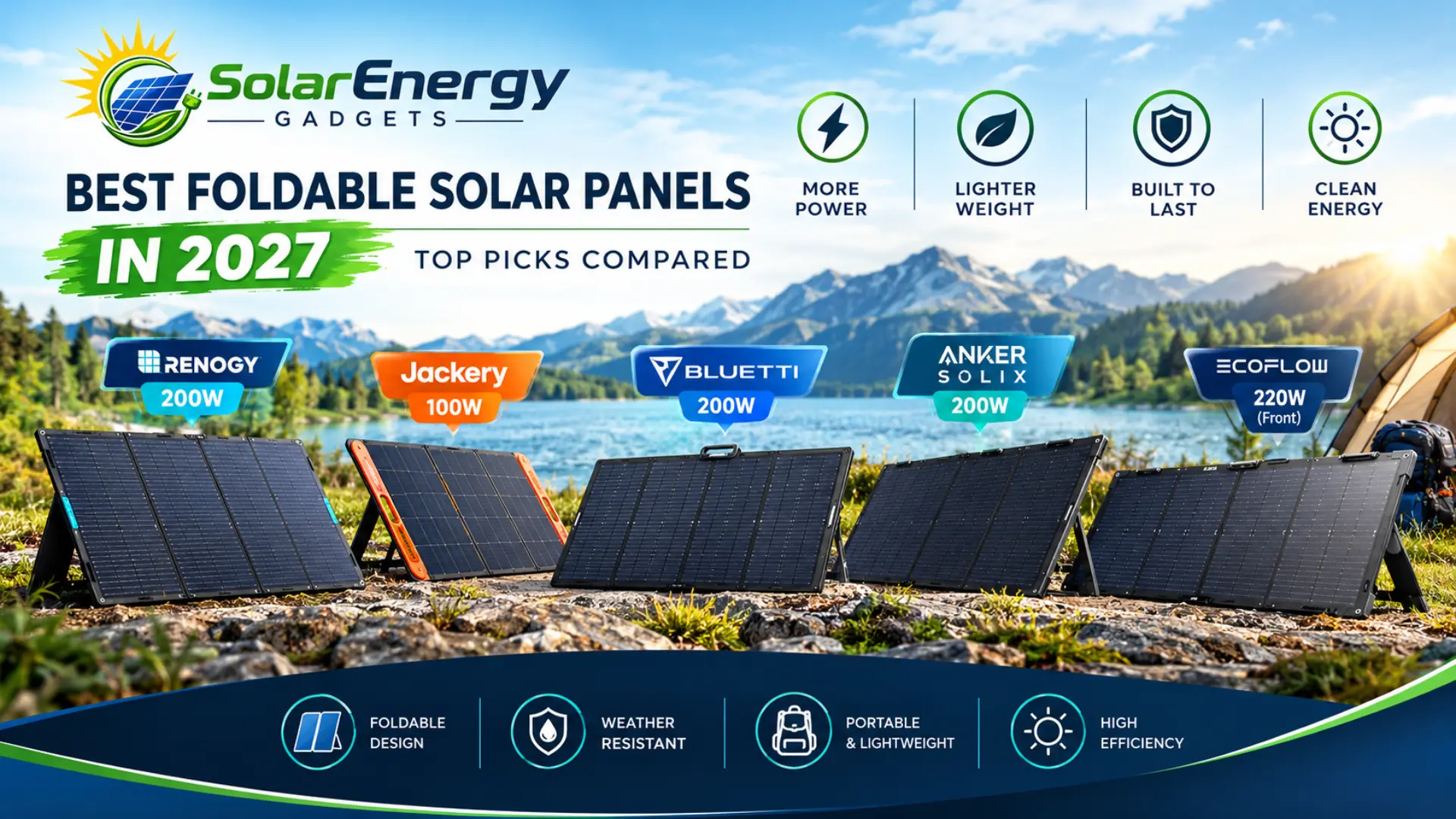
In this guide, we compare five of the best foldable solar panels, also known as portable solar panels available in the US, including Renogy, Jackery, BLUETTI, Anker SOLIX, and EcoFlow. You’ll find their key specifications, pros and cons, prices, and purchase links, along with practical tips for choosing a panel that works with your power station. Whether you want the best value, a lightweight design, or higher solar output, this comparison will help you make an informed buying decision.
Quick Comparison of Foldable Solar Panels
| Panel | Rated power | Weight | Weight per 100W | Weather rating | Price | Price per watt |
| Renogy E.Flex 200W N-Type | 200W | 13.89 lb | 6.9 lb | IP65 | $219.99 | about $1.10 |
| Jackery SolarSaga 100 Air | 100W | 7.1 lb | 7.1 lb | IP68 | $249 | about $2.49 |
| BLUETTI 200W Portable (SP200L) | 200W | 17.15 lb | 8.6 lb | IP67 (listed) | $399 | about $2.00 |
| Anker SOLIX PS200 Bifacial | 200W | 10.6 lb | 5.3 lb | IP68 | $499.99 | about $2.50 |
| Original EcoFlow 220W Bifacial | 220W front | 20.9 lb | 9.5 lb | IP68 | $549 | about $2.50 |
Note: Prices were checked on October 21, 2026, and change often. Price per watt and weight per 100W use each panel’s front-side rating. Lower weight per 100W means more power for the weight you carry.
How We Compared These Panels
We rated all panels based on their specifications, available on the manufacturers’ websites and, in the case of Anker and EcoFlow, on their product listings from the US-based retailers. The ranking is determined by the features, convenience, efficiency, and total value of each model—this rating is not a result of any lab testing. The actual solar energy production depends on many factors.
1. Best Value: Renogy E.Flex 200W N-Type Portable Solar Panel
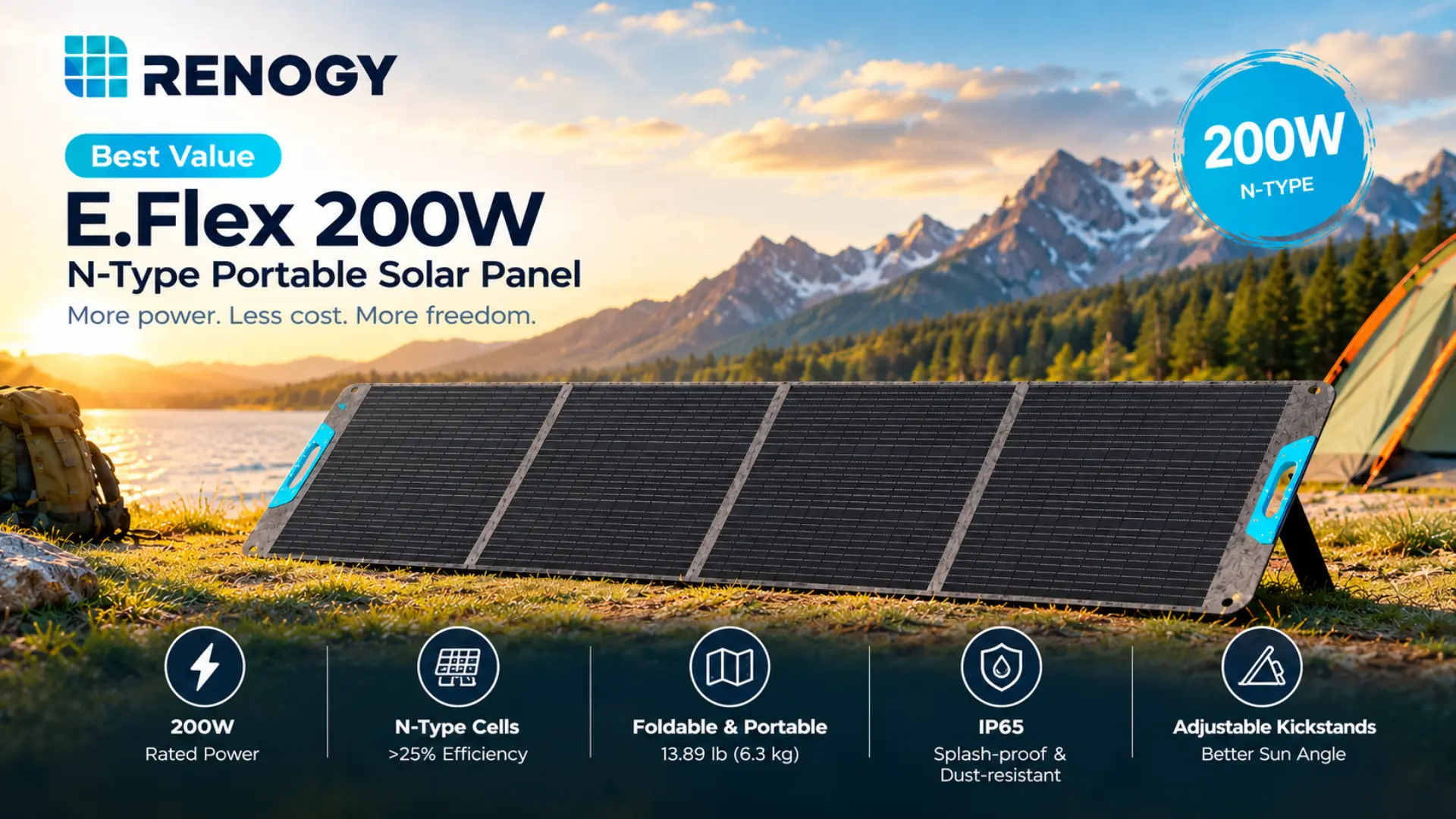
At roughly $1.10 per watt, the E.Flex costs about half as much per watt as the other panels here. Renogy pairs N-type cells rated above 25% efficiency with a foldable design that weighs 13.89 lb (6.3 kg) and includes a carry handle and adjustable kickstands.
Key specs
- Rated power: 200W
- Open-circuit voltage: 21.6V, short-circuit current 11.3A
- Folded size: 23.72 × 22.99 × 1.97 in
- Unfolded size: 87.80 × 22.99 × 0.12 in
- Weather rating: IP65 (Renogy describes it as splash-proof and dust-resistant)
- Operating temperature: 14°F to 149°F
- Warranty: 2 years
Pros: Lowest price per watt by a wide margin, a respectable weight for a 200W panel, and a long list of safety and compliance certifications on Renogy’s spec sheet.
Cons: IP65 is a lower rating than the IP68 panels here. One buyer on Renogy’s own page says an excellent day produced only about 150W, and others wished for longer cables. The 200W version was listed as backordered when we checked.
Best for: Budget-minded campers and RV owners. Renogy advises making sure the panel’s open-circuit voltage does not exceed your power station’s or charge controller’s maximum DC input rating.
Check the price of the Renogy E.Flex 200W →
2. Best Lightweight Pick: Jackery SolarSaga 100 Air
The SolarSaga 100 Air weighs just 7.1 lb (3.2 kg), which Jackery says is 27% lighter than the average 100W panel. It uses dual-sided PERC cells rated up to 23% efficiency and sets up in about 60 seconds with a built-in aluminum stand.
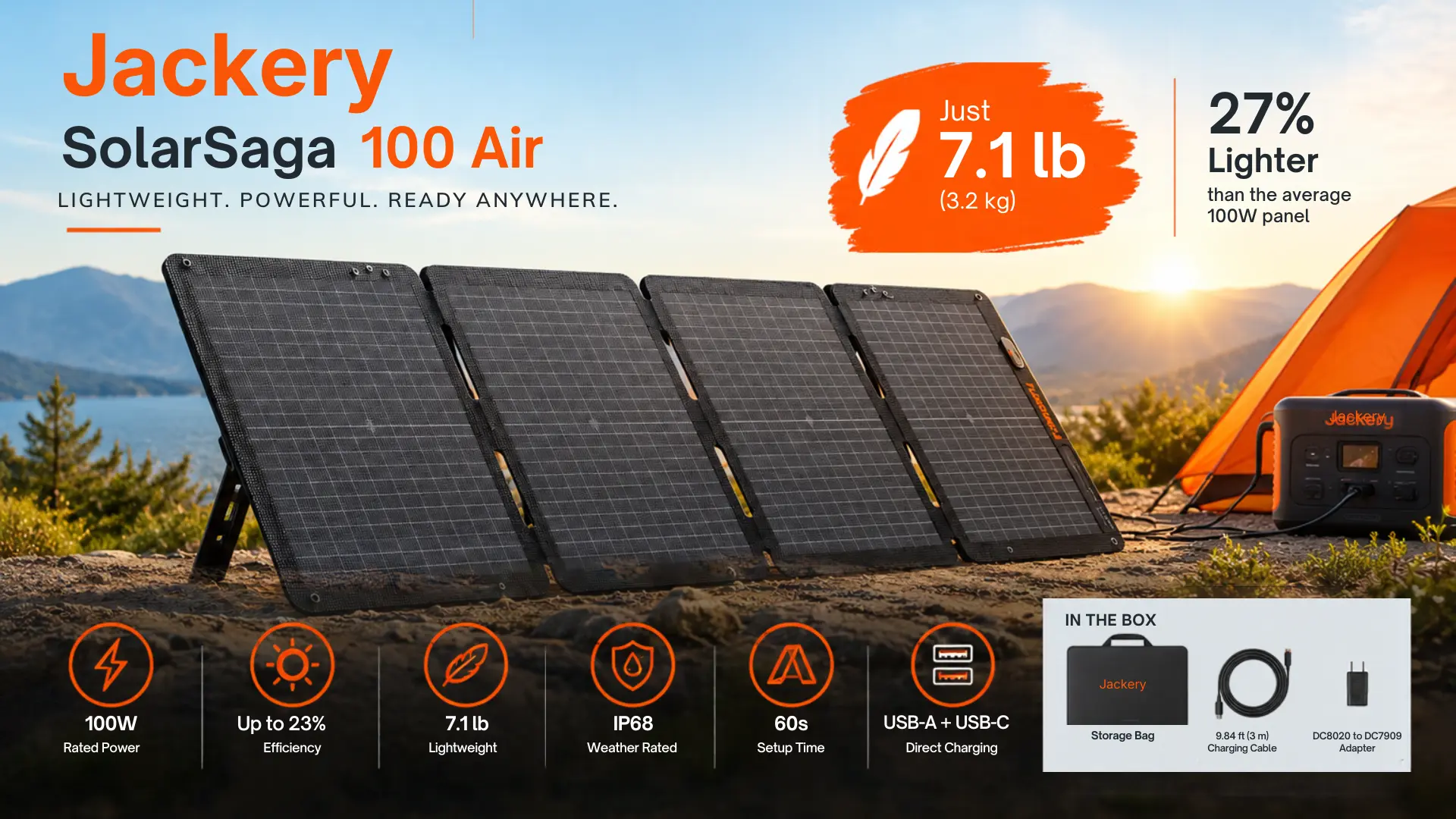
Key specs
- Rated power: 100W
- Weight: 7.1 lb
- Weather rating: IP68, tested through 4,000 fold cycles
- Operating temperature: -4°F to 149°F
- Outputs: 100W power output plus USB-A and USB-C ports for direct device charging
- In the box: storage bag, 9.84 ft (3 m) charging cable, DC8020 to DC7909 adapter
- Warranty: 1 year, extended to 3 years when bought at Jackery.com
Pros: The lightest panel in this guide, a compact W-fold design, and direct USB charging for phones and small gadgets. Buyers on Jackery’s page report 100–109W on sunny days.
Cons: At 100W it recharges a large station slowly, and the price per watt is high. Jackery lists it as not compatible with the Explorer 300 v2, Explorer 300, 300D or 240D for recharging.
Best for: Hikers, backpackers and anyone who prizes low weight over raw output.
Check the price of the Jackery SolarSaga 100 Air →
3. Best Mid-Priced 200W Panel: BLUETTI 200W Portable Solar Panel (SP200L)
Bluetti’s 200W panel sits between the Renogy and the premium panels at $399, or about $2.00 per watt. Its monocrystalline cells are rated up to 23.4% efficient, and it uses standard MC4 connectors. Bluetti’s US page lists it as the SP200L, while some reviews and FAQs call it the PV200. The specs below are for the SP200L only.
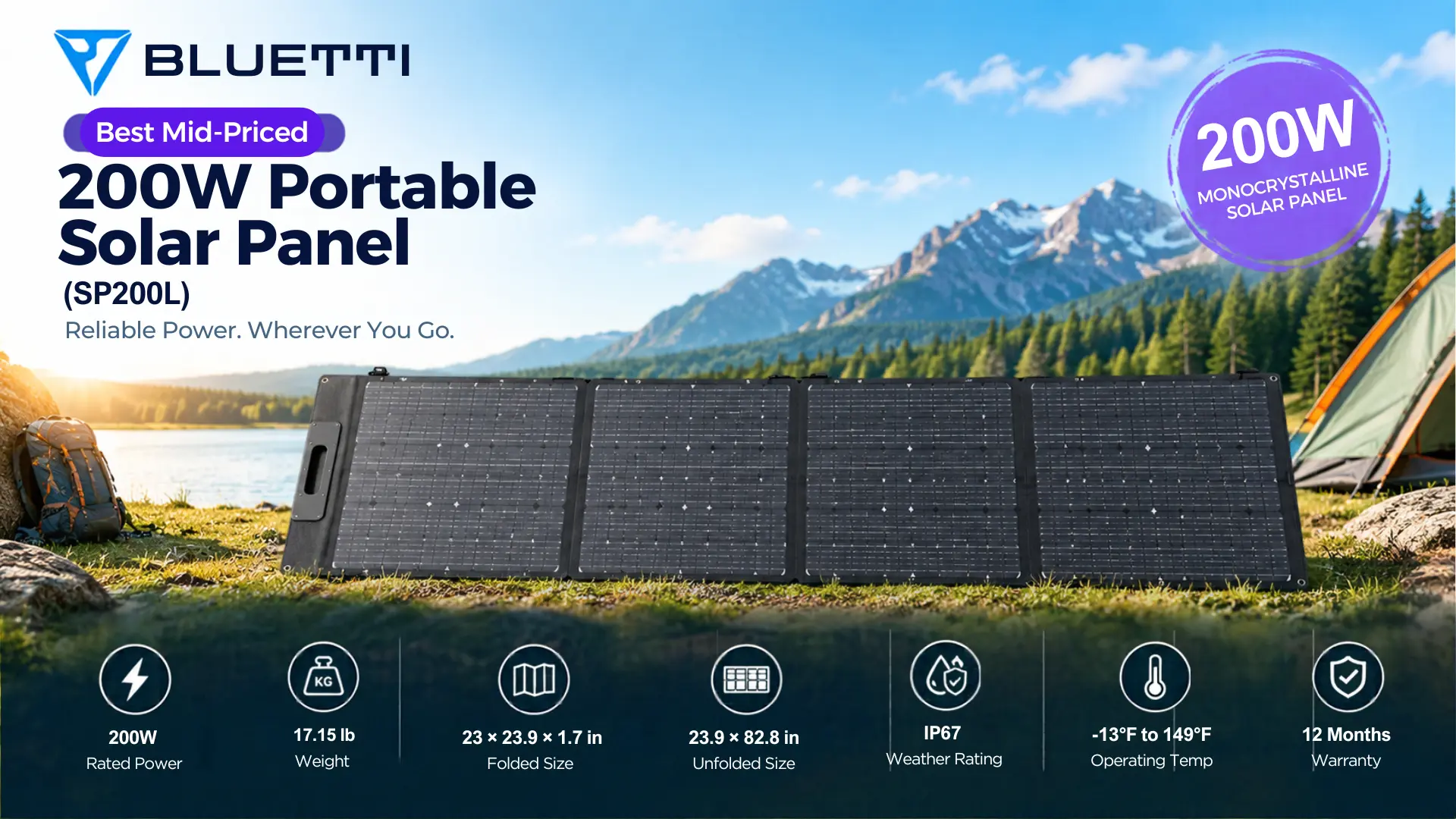
Key specs
- Rated power: 200W
- Open-circuit voltage: 24.6V, short-circuit current 10.8A
- Weight: 17.15 lb (8.14 kg)
- Folded size: 23 × 23.9 × 1.7 in
- Unfolded size: 23.9 × 82.8 in
- Weather rating: IP67 (as listed)
- Operating temperature: -13°F to 149°F
- Connector: MC4
- Warranty: 12 months
Pros: A mid-range price, standard MC4 connectors, and a compact folded size for storage.
Cons: At 17.15 lb it’s heavier than the Renogy, Jackery and Anker panels. Bluetti’s page doesn’t say whether a cable is included, and its FAQ describes the panel as splash resistant even though the spec lists IP67, so don’t leave it sitting in water. The warranty is only 12 months, and the page mentions a ship date of October 23, so confirm delivery timing.
Best for: Bluetti power station owners and anyone who wants a 200W panel with MC4 connectors. Check your station’s maximum input voltage first.
Check the price of the BLUETTI 200W Portable Solar Panel →
4. Best Premium 200W Panel: Anker SOLIX PS200 Bifacial
At 10.6 lb, Anker’s PS200 is the lightest 200W panel in this group. It combines N-type cells rated above 25% with a dual-sided design that Anker says can add up to 10% more power over reflective surfaces such as snow, sand or concrete.

Key specs
- Rated power: 200W
- PV output: 48V at 4.16A
- Weight: 10.6 lb
- Unfolded size: 54.2 × 31.2 × 0.7 in
- Folded size: 27.0 × 31.2 × 1.8 in
- Weather rating: IP68
- In the box: two 8.2 ft solar cables and a 1.6 ft XT-60i cable
- Warranty: 5 years
Pros: The best weight-to-power ratio here, the longest warranty in the group, and a rear-side power boost.
Cons: The price per watt is about the same as the EcoFlow and Jackery panels and well above the Renogy. The panel has one fixed tilt angle, and Anker says the bracket allows only slight adjustments. Anker also warns that the black frame can heat up in the sun and that the panel should not be exposed to heavy rain or submerged, even with its IP68 rating.
Best for: Frequent travelers who want a light 200W panel and own a power station that accepts its 48V operating voltage. Check your station’s maximum solar input voltage before buying.
Check the price of the Anker SOLIX PS200 →
5. Best Bifacial Output: Original EcoFlow 220W Bifacial Portable Solar Panel
The original EcoFlow 220W Bifacial is the heaviest panel here at 20.9 lb, but it has the highest front-side rating. It delivers 220W from the front and carries a 155W rating on the back for reflected light. EcoFlow says the two-sided design can capture up to 25% more energy, and some retailer listings describe a gain of 5–25% depending on the surface underneath. EcoFlow sells other bifacial panels too, so confirm the listing matches the specs below.
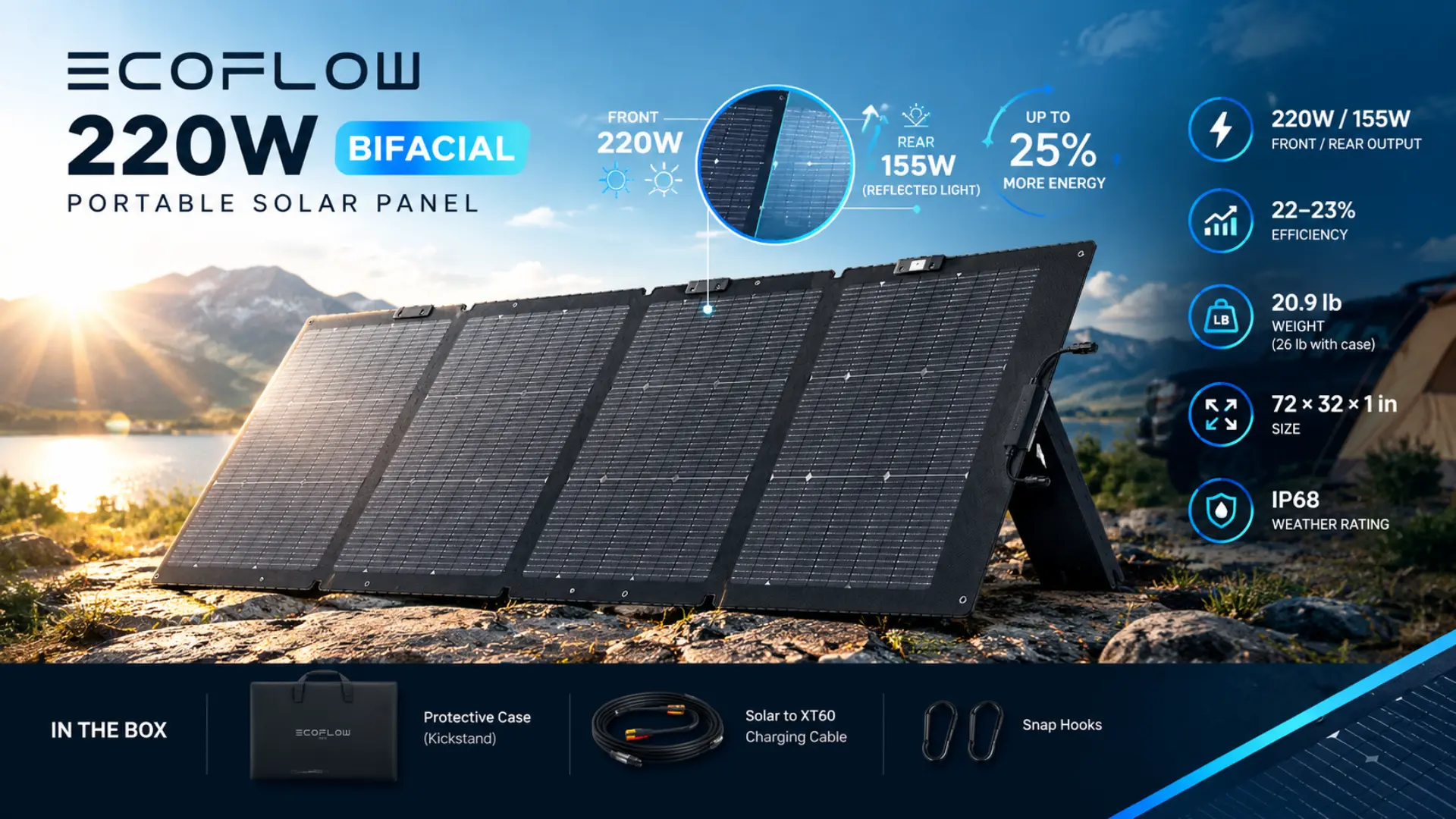
Key specs
- Rated power: 220W front, 155W rear (rear output depends on reflected light)
- Efficiency: 22–23%
- Weight: 20.9 lb (about 26 lb with the kickstand case)
- Size: about 72 × 32 × 1 in
- Open-circuit voltage: 21.8V, front short-circuit current 13A
- Weather rating: IP68
- In the box: protective case that doubles as a kickstand, solar-to-XT60 charging cable, snap hooks
Pros: The highest rated output, single-piece tempered glass that EcoFlow says is five times more durable than comparable panels, and a protective case with a built-in kickstand.
Cons: It is the heaviest and the most expensive panel in this guide. The included cable is a Solar to XT60 type, so if you use a non-EcoFlow station, check connector compatibility first. The listing we checked showed it as backordered.
Best for: EcoFlow power station owners and anyone who wants a rugged, high-output panel and can carry the extra weight.
Check the price of the Original EcoFlow 220W Bifacial Panel →
How to Choose a Foldable Solar Panel
Match the panel to your power station. Check the station’s maximum solar input in watts, volts and amps, and confirm the connector type. The panel’s open-circuit voltage must stay below the station’s maximum input voltage, and some brand pairings are explicitly unsupported.
Expect less than the rated wattage. Anker’s FAQ states that actual power can fall below the rating depending on sunlight, orientation and angle. Treat the label as a best case, especially in cloudy weather or during winter.
Weigh portability against output. These panels range from 5.3 to 9.5 lb per 100W. If you hike to your campsite, a lighter panel can matter more than the last few watts.
Check the manufacturer’s weather instructions. IP ratings describe protection against dust and water under defined test conditions. They don’t make every portable panel suitable for storms, prolonged exposure or immersion. Follow your model’s manual for rain, storage and operating precautions.
Compare warranties and price per watt. Anker offers 5 years, Renogy 2 years, Bluetti 12 months, and Jackery 1 year (up to 3 years when bought at Jackery.com). Check EcoFlow’s current terms at checkout. Price per watt here runs from about $1.10 to $2.50.
Frequently Asked Questions
What is the difference between foldable and portable solar panels?
The main difference is that foldable solar panels are designed to fold for storage, while portable solar panels are any solar panels designed to be moved easily. Foldable panels are a type of portable solar panel, but not all portable panels fold.
What is the best portable solar panel for a power station?
The Renogy E.Flex 200W offers great value, the Jackery SolarSaga 100 Air is ideal for lightweight travel, and the Anker SOLIX PS200 balances portability and power. Choose one compatible with your power station.
How long does a 200W solar panel take to charge a 1,000Wh power station?
Under favorable conditions, it may take around two good solar days. Actual charging time depends on sunlight, weather, and charging losses.
Are portable solar panels worth buying?
Yes, they can help charge power stations for camping, RV trips, emergencies, and off-grid use without relying entirely on wall outlets.
Can I use any solar panel with any power station?
No. Check voltage, current, connectors, and maximum solar input limits before connecting a panel.
Do portable solar panels work on cloudy days?
Yes, but they produce less electricity than in direct sunlight. Heavy clouds and shade can reduce output significantly.
Is a 200W solar panel better than a 100W panel?
A 200W panel has twice the rated power, so it can generate more electricity under similar conditions. However, it may be larger and heavier.
Are bifacial solar panels worth the extra cost?
They can be, especially over reflective surfaces such as light-colored concrete or sand. The extra energy gain depends on the installation conditions.
What should I check before buying a portable solar panel?
Compare wattage, weight, folded size, connectors, voltage, weather resistance, warranty, and compatibility with your power station.
The Bottom Line of Best Foldable Solar Panels
The best foldable solar panel depends on your budget, requirements, and power station compatibility. The Renogy E.Flex 200W is the most affordable high-efficiency solar panel recommended by us. In case you prefer lightweight and compact devices, the Jackery SolarSaga 100 Air suits hikers perfectly. You should check out the BLUETTI 200W in case you need a 200W panel with an MC4 connector. The Anker SOLIX PS200 solar panel is another good option when it comes to the combination of power generation capability and portability. Nevertheless, make sure the voltage of the panel fits that of your power station.
In case you already use other products from the manufacturer and are looking for something durable and powerful enough to provide an additional boost of energy by capturing reflected light, consider buying the Original EcoFlow 220W Bifacial. Nonetheless, the extra weight will be felt during regular travels.
When you decide to purchase a new solar device, weigh all the differences between panels based on their weight, folded dimensions, type of connector, operating voltage, and maximum solar input capabilities.
The mission of Solar Energy Gadgets is to provide you with a way to compare different solar products based on their verified
Solar Energy Gadgets is a premier global hub for original, expert-led solar product reviews. Our dedicated team of specialists rigorously tests the latest renewable energy technology from around the world to ensure our readers receive unbiased and practical advice. Whether you are outfitting a suburban home or looking for the best off-grid gear, we provide the insights you need to harness the power of the sun with confidence.