Portable solar panels have become a must-have for campers, RV travelers, and off-grid enthusiasts across the United States. As energy independence and eco-friendly travel continue to rise in popularity, more Americans are turning to solar solutions to power their adventures.
Whether you’re exploring national parks, living the van life, or preparing for emergencies, portable solar panels offer a reliable and sustainable power source. In this guide, we’ll break down the top portable solar panels for camping & RV use in 2026, how to choose the right one, and what features matter most.
Why Portable Solar Panels Are a Game-Changer for Campers & RV Owners
Americans are spending more time outdoors than ever. According to the Outdoor Industry Association, over 168 million Americans participated in outdoor recreation in recent years — and a growing number are doing it off-grid. The demand for clean, silent, portable power has exploded, and solar panel manufacturers have responded.
Here’s why portable solar panels are the top choice for campers and RV travelers in 2026:
- No fuel costs — sunshine is free
- Silent operation — no generator noise at your campsite
- Lightweight and foldable designs fit in a backpack or under an RV seat
- Compatible with solar generators, power stations, and 12V RV systems
- Zero emissions — better for the environment and national park rules
What to Look for When Buying a Portable Solar Panel
Not all solar panels are created equal. Before you buy, here are the key specs to understand:
1. Wattage (Power Output)
Wattage determines how fast a panel charges your devices or battery. For casual campers charging phones and small gadgets, a 60-100W panel is usually sufficient. RV owners running refrigerators, lights, and larger appliances should look at 200W+ systems or multiple panels chained together.
Pro Tip*: A 100W solar panel in full sun generates around 300-500Wh per day — enough to charge a typical laptop 3-4 times.
2. Panel Efficiency
Efficiency measures how well a panel converts sunlight into electricity. Most portable panels fall between 20-24% efficiency. Monocrystalline panels are the most efficient and perform better in low-light conditions, making them ideal for camping in shaded or overcast areas.
3. Weight and Portability
If you’re backpacking, every pound counts. Look for panels under 5 lbs for hiking use. For RV use, weight matters less, but foldable and rollable designs still make storage and setup much easier.
4. Durability and Weather Resistance
Your panel needs to handle dust, rain, and the occasional drop. Look for an IP67 or IP68 waterproof rating, tempered glass or ETFE coating, and reinforced corner protection. Rigid panels are more durable; flexible panels are lighter but can be less long-lasting.
5. Connector Type and Compatibility
Make sure your panel’s output connector matches your power station or battery. Most modern portable panels use XT60, MC4, or Anderson connectors. Many also include USB-A and USB-C ports for direct device charging.
Types of Portable Solar Panels for Camping & RV
Understanding the types of solar panels helps you make the best choice.
1. Foldable Solar Panels
- Lightweight and compact
- Easy to carry and store
- Ideal for camping trips
2. Rigid Portable Panels
- More durable
- Higher efficiency
- Better for long-term RV setups
3. Solar Blanket Panels
- Ultra-lightweight
- Flexible design
- Great for backpackers
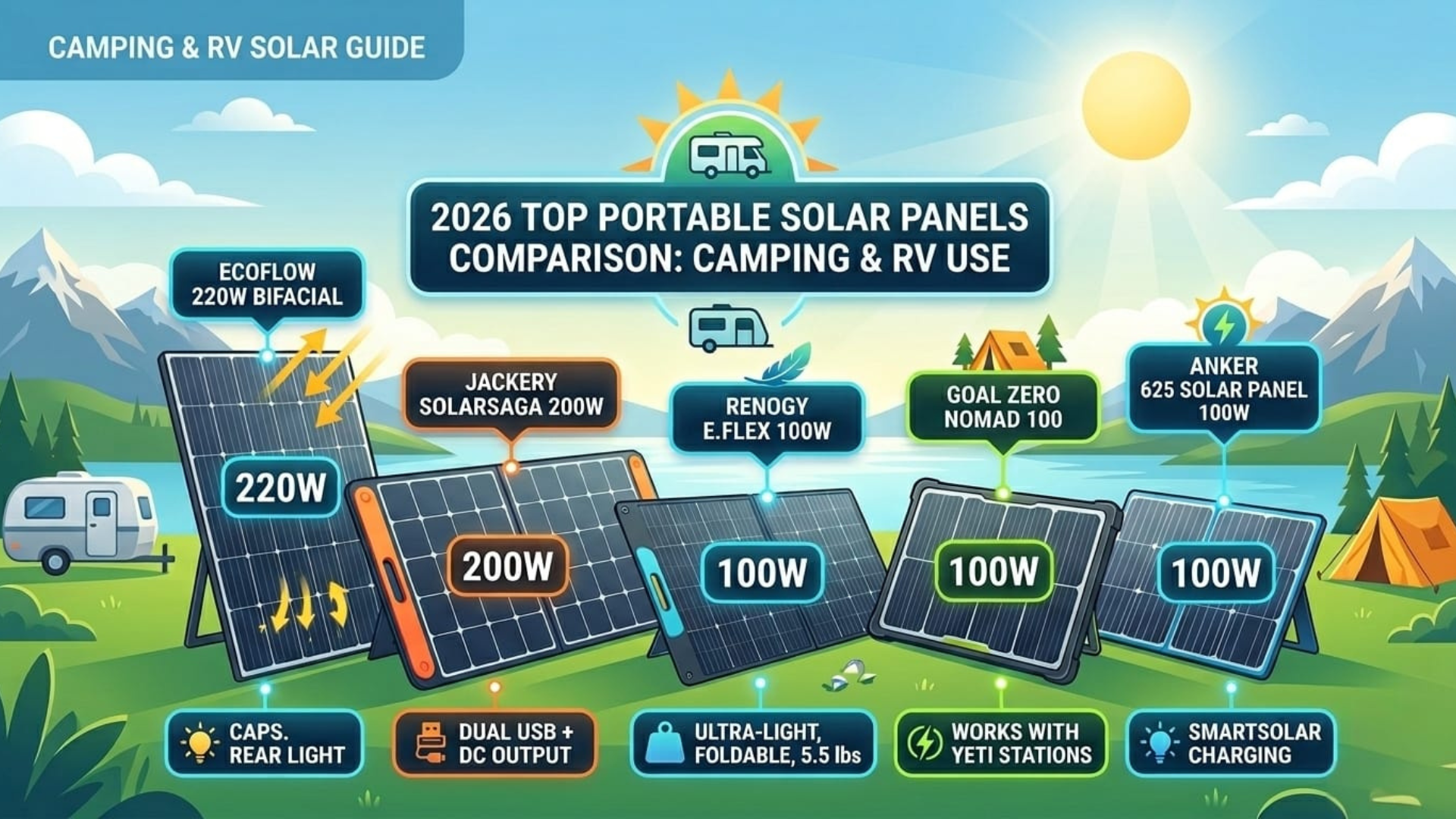
Top Portable Solar Panels for Camping & RV Use in 2026 — Quick Comparison
| Product | Wattage | Weight | Best For | Standout Feature |
| Jackery SolarSaga 200W | 200W | 10.3 lbs | RV & base camp | Dual USB + DC output |
| Goal Zero Nomad 100 | 100W | 8.5 lbs | Weekend camping | Works with Yeti stations |
| Renogy E.FLEX 100W | 100W | 5.5 lbs | Backpacking & RV | Ultra-light, foldable |
| EcoFlow 220W Bifacial | 220W | 13.8 lbs | High-power RV use | Captures rear-side light |
| Anker 625 Solar Panel 100W | 100W | 9.0 lbs | All-around camper | SmartSolar charging tech |
Portable Solar Panel Price Comparison (USA 2026)
| Model | Wattage | Approx Price (USD) |
| Jackery SolarSaga 200W | 200W | $379 – $479 |
| Goal Zero Nomad 100 | 100W | $299 – $399 |
| Renogy E.FLEX 100W | 100W | $200 – $260 |
| EcoFlow 220W Bifacial | 220W | $499 – $599 |
| Anker 625 Solar Panel (100W) | 100W | $250 – $330 |
Best Portable Solar Panels — Full Reviews
1. Jackery SolarSaga 200W — Best Overall for RV Use
Price Range: $379 – $479 | Weight: 10.3 lbs | Output: 200W
The Jackery SolarSaga 200W is one of the most popular portable solar panels for RV and car camping in 2026 — and for good reason. It folds flat for easy transport, unfolds in seconds, and delivers serious wattage for charging Jackery power stations or compatible solar generators.
The panel features dual USB-A ports, a USB-C port, and a DC output — so you can charge devices directly while simultaneously filling your power station. ETFE-laminated coating means it’s built to last in tough outdoor conditions.
- Highly compatible with Jackery Explorer power stations
- ETFE coating for improved durability and efficiency
- Folds down to a briefcase-style form factor for easy storage
Best For: RV travelers and base campers who already own a Jackery power station.
2. Goal Zero Nomad 100W — Best for Ecosystem Users
Price Range: $299 – $399 | Weight: 8.5 lbs | Output: 100W
Goal Zero has long been a trusted name in the off-grid power space, and the Nomad 100 continues that tradition. It’s designed to integrate seamlessly with Goal Zero’s Yeti power station lineup — a major selling point if you’re already in their ecosystem.
The panel features a kickstand, two USB ports, and an 8mm output port for connecting to Yeti stations directly. Monocrystalline cells deliver consistent performance even in partial shade.
- Kickstand included for optimal sun angle adjustment
- Durable, weather-resistant build with carry handle
- Chains with other Goal Zero panels for higher output
Best For: Campers and RV owners invested in the Goal Zero power station ecosystem.
3. Renogy E.FLEX 100W — Best Lightweight Option
Price Range: $200 – $260 | Weight: 5.5 lbs | Output: 100W
At just 5.5 lbs for a 100W panel, the Renogy E.FLEX is a standout option for campers who want maximum power without the weight penalty. It folds down to a compact rectangle that slips easily into a backpack side pocket or under an RV bunk.
Renogy is one of the most reputable solar brands in the US, known for quality at accessible price points. The E.FLEX series delivers on that promise — reliable, efficient, and simple to use.
- Lightest 100W portable panel in its class
- Includes MC4 connectors for wide compatibility
- IP67 waterproof rating for all-weather use
Best For: Lightweight backpackers and campers who want the best watts-per-pound ratio.
4. EcoFlow 220W Bifacial Panel — Best High-Output Option
Price Range: $499 – $599 | Weight: 13.8 lbs | Output: 220W
The EcoFlow 220W Bifacial panel is the power user’s choice. What makes it unique is its bifacial design — the panel generates electricity from both the front and back, capturing reflected ground light to deliver up to 25% more output than standard panels.
This is an ideal pick for full-time RV dwellers, overlanders, or anyone who needs to run appliances like a mini fridge, CPAP machine, or portable AC unit off-grid.
- Bifacial cells generate power from both sides
- IP68 waterproof — built for harsh outdoor conditions
- Pairs with EcoFlow DELTA power stations for a complete off-grid system
Best For: Full-time RV travelers and serious off-gridders who need maximum solar output.
5. Anker 625 Solar Panel 100W— Best All-Rounder
Price Range: $250 – $330 | Weight: 9.0 lbs | Output: 100W
Anker brings its consumer electronics expertise to the solar space with the 625 Solar Panel. Its SmartSolar technology automatically detects your device and delivers the optimal charge speed, reducing charging times compared to generic panels.
The panel is foldable, features a kickstand, and includes a USB-C and USB-A port for direct charging. A great all-around choice that works with most popular solar generators and power stations.
- SmartSolar tech optimizes charge speed per device
- Foldable with a built-in kickstand
- Compatible with Anker SOLIX and most third-party power stations
Best For: Campers who want a reliable, tech-forward option from a trusted US brand.
Tips for Getting the Most Out of Your Portable Solar Panel
Even the best solar panel won’t perform well if you set it up wrong. Here are practical tips to maximize your power output on any camping or RV trip:
- Angle your panel toward the sun: Tilt at an angle equal to your latitude for best exposure. Most panels come with adjustable kickstands for this.
- Avoid shade at all costs: Even partial shading of a single cell can reduce the output of the entire panel. Position away from trees, RV awnings, or any overhead obstructions.
- Keep panels clean: Dust, bird droppings, and pollen can reduce efficiency by 15-25%. Wipe down with a soft cloth regularly on longer trips.
- Use an MPPT charge controller: For RV setups wired into a battery bank, an MPPT controller will squeeze significantly more energy from your panels than a basic PWM controller.
- Pair with a quality power station: A good portable solar panel paired with a power station like the Jackery Explorer, EcoFlow DELTA, or Goal Zero Yeti creates a complete off-grid system that can run your campsite for days.
Frequently Asked Questions about Portable Solar Panels
How many watts do I need for camping?
For basic device charging (phone, tablet, headlamp), a 28-60W panel is plenty. For running a portable fridge, laptop, and charging a power station simultaneously, aim for 100-200W.
Can I leave my solar panel out in the rain?
Most quality portable panels are water-resistant to IP67 or IP68 standards, meaning they can handle rain. However, submerging them or leaving them in standing water is not recommended.
What’s the best solar panel for RV use?
The Jackery SolarSaga 200W and EcoFlow 220W Bifacial are our top picks for RV use thanks to their high wattage, durable build, and compatibility with popular power stations.
Do solar panels work on cloudy days?
Yes, but at reduced efficiency — typically 10-25% of rated output. Monocrystalline panels perform better in overcast conditions than polycrystalline panels.
What is the best portable solar panel for van life?
For van life, the Renogy E.FLEX 100W and Jackery SolarSaga 200W are top picks. They’re lightweight, durable, and can be roof-mounted or used as portable ground panels depending on your parking situation.
Final Thoughts: Choosing the Best Portable Solar Panel for Your Adventure
In 2026, there’s a portable solar panel for every type of outdoor adventurer — from ultralight backpackers to full-time RV families. The key is matching your panel’s wattage, weight, and compatibility to your actual power needs.
Our top overall pick remains the Jackery SolarSaga 200W for its versatility, build quality, and seamless integration with one of the most popular power station ecosystems in the US. For budget-conscious hikers, Renogy E.FLEX 100W punches well above its price tag.
Whatever you choose, investing in a quality portable solar panel means free, clean, silent power — wherever the road takes you.